Table of Contents
- Why Pet Dental Cleaning Costs Vary So Much
- What Is Included in a Professional Pet Dental Cleaning
- The Importance of Pre-Anesthetic Bloodwork for Pets
- Pet Dental X-Rays: Why They Matter and Add to Cost
- How to Find Affordable Pet Dental Care in Bedford, New Hampshire
- Understanding Anesthesia Risk and Monitoring Costs
- Key Differences Between Facilities
- What Happens If Your Pet Needs Extractions
- Preventative Dental Care Reduces Future Costs
- Frequently Asked Questions
Last Updated: August 8, 2026
Why Pet Dental Cleaning Costs Vary So Much
Pet dental cleaning costs vary dramatically because the procedure involves far more than brushing teeth. Expense depends on your pet’s oral health, procedure complexity, and facility type. A routine cleaning for a young dog with minimal plaque differs entirely from extracting diseased teeth from a senior cat with advanced periodontal disease, one takes 30 minutes; the other takes two hours.
CorePet understands this variability because we focus exclusively on dental procedures alongside Spay Neuter Dental services. Below, we’ll walk you through exactly what influences your bill and how to evaluate quotes fairly.
What Is Included in a Professional Pet Dental Cleaning
A professional pet dental cleaning is a multi-step medical procedure called dental prophylaxis that requires general anesthesia, specialized equipment, and trained veterinary technicians monitoring your pet throughout.
The procedure begins with a pre-operative oral examination assessing teeth, gums, and surrounding tissues for gingivitis, calculus, and teeth needing extraction. Ultrasonic scaling removes plaque and tartar from above and below the gum line. After scaling, the veterinarian polishes tooth surfaces and applies fluoride treatment to strengthen enamel. A veterinary technician monitors anesthesia and vital signs throughout, using intubation to protect the airway and maintain oxygen levels.
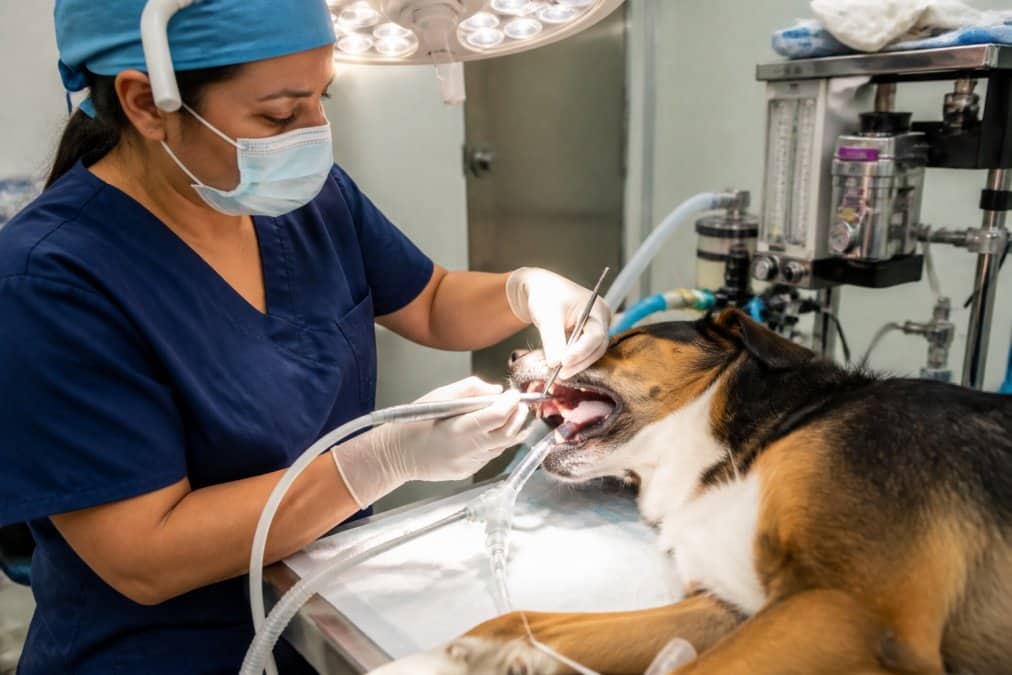
Professional cleaning often reveals problems invisible to the naked eye. Dental radiographs (X-rays) assess tooth roots, detect hidden decay, and identify teeth requiring extraction. If extractions are necessary, that’s additional surgical time and complexity. A routine cleaning might take 45 minutes; a senior pet with multiple extractions might take three hours.
The Importance of Pre-Anesthetic Bloodwork for Pets
Pre-anesthetic bloodwork is one of the most important line items on your dental cleaning quote. General anesthesia affects the heart, lungs, liver, and kidneys. Before anesthesia, a veterinarian needs to know whether those organs can handle it safely.
The pre-anesthetic panel typically includes a complete blood count and chemistry profile checking red and white blood cell counts, liver enzymes, kidney function, blood glucose, and electrolyte balance. This is standard medical practice that directly impacts safety. Without bloodwork, a veterinarian cannot safely proceed. If a quote omits pre-anesthetic bloodwork, ask why, a low quote without this safety measure is a red flag.
Pet Dental X-Rays: Why They Matter and Add to Cost
Dental radiographs (X-rays) are essential to thorough dental care. What you see on the surface tells only part of the story. X-rays reveal what’s happening below the gum line and inside the tooth root.
Periodontal disease can destroy bone and tissue long before visible symptoms appear. X-rays show this damage, reveal tooth root fractures, abscesses, and decay that would otherwise go undetected. Without radiographs, a veterinarian might clean a tooth that should be extracted or extract a tooth that could have been saved. When evaluating quotes, ask whether dental X-rays are included and how many will be taken.
How to Find Affordable Pet Dental Care in Bedford, New Hampshire
Finding affordable pet dental care means understanding what you’re paying for and comparing apples to apples. Start by asking what’s included in the quoted price: pre-anesthetic bloodwork, dental X-rays, pain medication after the procedure, and extractions if needed. Some facilities quote a base price for cleaning, then add charges for each service. Others bundle everything.

When calling around Bedford, New Hampshire, ask specifically about post-operative care. Does the quote include pain medication for days following the procedure? Ask about anesthesia-free dentistry options. While advertised as budget-friendly, anesthesia-free cleaning only addresses plaque above the gum line and cannot perform subgingival cleaning where most periodontal disease lives. The most affordable care is the care that prevents future problems through thorough evaluation and proper treatment.
Understanding Anesthesia Risk and Monitoring Costs
Anesthesia is necessary for professional dental cleaning but carries inherent risk. Modern anesthesia protocols are remarkably safe with proper monitoring. A veterinary technician watching vital signs continuously, adjusting anesthetic depth, and being ready to respond to complications costs money. Ask what monitoring equipment is used: pulse oximetry, capnography, blood pressure monitoring, ECG, and temperature monitoring are standard safety measures.
Recovery also varies. Some facilities observe pets for several hours after the procedure; others send them home immediately. Longer observation costs more but catches complications early.
Key Differences Between Facilities
Not all facilities offering dental cleaning are equivalent. A dedicated dental surgery center typically has more specialized equipment than a general veterinary practice. Ultrasonic scalers, digital radiography systems, surgical lights, and modern anesthesia machines are expensive investments.
Staff training matters enormously. A veterinary technician performing dental cleanings daily develops skills and efficiency that someone doing one cleaning per week cannot match. A dedicated surgical suite with proper ventilation, lighting, and sterile protocols differs significantly from a corner of a general practice. When comparing quotes, ask about facility credentials, veterinarian and technician experience, and equipment used.
What Happens If Your Pet Needs Extractions
Tooth extraction adds complexity to dental cleaning. Cost depends on how many teeth need removal and extraction difficulty. A simple extraction of a single-root tooth might take five minutes. A molar with multiple curved roots might take 30 minutes and require bone removal.
Pre-operative exams and X-rays become invaluable here. A veterinarian can often predict which extractions will be straightforward and which will be complex, allowing for more accurate quotes. After extraction, your pet needs pain management as the socket heals over several weeks.
Preventative Dental Care Reduces Future Costs
The most effective way to manage pet dental cleaning costs is preventing serious dental disease. Regular home care, appropriate diet, and early professional intervention dramatically reduce the need for extensive cleaning and extractions.
Daily tooth brushing removes plaque before it hardens into calculus. Even a few times per week makes a meaningful difference. Regular oral examinations catch problems early. A pet with early gingivitis caught at a wellness exam might need a simple cleaning. The same pet left untreated for two years might need multiple extractions.
Finding the right balance between cost and quality care means understanding what drives variation in pet dental cleaning prices. Pre-anesthetic bloodwork, dental X-rays, anesthesia monitoring, and procedure complexity all contribute to your final bill. Rather than shopping purely on price, evaluate what’s included in each quote and whether the facility invests in safety measures and diagnostic tools that protect your pet.
CorePet focuses on providing transparent, comprehensive dental care for dogs, cats, and rabbits in the Bedford, New Hampshire area. We include pre-anesthetic bloodwork, dental radiographs, and proper anesthesia monitoring as standard practice because your pet’s safety matters more than cutting corners. When you’re ready to discuss your pet’s dental needs, book an appointment to see how we can help.
Frequently Asked Questions
Why are pet dental cleaning costs so much higher than human cleanings?
Pet dental cleanings require general anesthesia because animals cannot cooperate during the procedure like humans can. Anesthesia adds significant cost because it requires pre-anesthetic bloodwork, monitoring equipment, an anesthesiologist or trained technician, intubation, vital signs monitoring throughout recovery, and pain management afterward. Additionally, veterinary overhead, surgical suite maintenance, specialized equipment, and trained staff, is higher than human dental offices. The procedure itself is also more complex, often involving tooth extractions, subgingival cleaning below the gum line, and dental radiographs to assess periodontal disease.
What is included in a professional pet dental cleaning?
A complete professional dental cleaning includes a thorough oral examination, ultrasonic scaling to remove plaque and calculus, subgingival cleaning below the gum line, dental radiographs (X-rays) to detect hidden disease, tooth polishing, and any necessary extractions. Pre-operative bloodwork and anesthesia monitoring are also included, along with post-operative pain management. Some clinics include a take-home care plan to prevent future periodontal disease. Always ask your veterinarian for an itemized quote to confirm exactly what is covered.
Does pet insurance cover dental cleaning costs?
Most standard pet insurance plans do not cover routine dental cleanings because they are considered preventative care. However, some policies cover dental disease treatment if gingivitis or periodontal disease is diagnosed. Coverage varies significantly by plan and provider, so review your policy documents or contact your insurer directly. Some pet owners set aside savings specifically for dental care since it is a predictable expense that becomes more common as pets age.
How can I reduce the cost of my pet’s dental cleaning?
Focus on preventative care at home: brush your pet’s teeth regularly, provide dental-friendly toys, and maintain annual oral health exams. Early detection of gingivitis or plaque accumulation prevents more expensive extractions later. Ask your veterinarian about dental prophylaxis schedules based on your pet’s age and risk factors. When you receive a quote, request an itemized breakdown and ask if bloodwork, pain medication, or radiographs are bundled or separate. Some surgery centers focusing exclusively on dental procedures may offer more competitive pricing than full-service veterinary hospitals due to operational efficiency.
This article was written using GrandRanker