Table of Contents
- Dog Incision Healing Stages: What Normal Looks Like
- Signs of Infection in Dog Stitches and How to Check Daily
- Preventing Dog Incision Licking and Scratching
- Monitoring for Systemic Symptoms and When to Contact Your Veterinarian
- Understanding Incision Integrity and Sutures Versus Staples
- A Visual Identification Guide for Concerned Owners
- Frequently Asked Questions
Last Updated: September 16, 2026
Dog Incision Healing Stages: What Normal Looks Like
Checking for a dog incision infection starts with knowing what normal healing looks like. Healing unfolds in three phases: inflammatory (days 1-5), with mild redness, warmth, and clear discharge; proliferative, when granulation tissue forms and edges knit; and maturation, when swelling resolves over weeks.
| Stage | Timeline | What You’ll See | What’s Normal |
|---|---|---|---|
| Inflammatory | Days 1-5 | Mild erythema, slight warmth, small amount of clear discharge | Redness at wound edges, minor crusting |
| Proliferative | Days 5-14 | Granulation tissue forming, edges closing | Reduced swelling, less discharge |
| Maturation | Weeks 2-8+ | Scar tissue maturing, swelling resolving | Incision line fading, no discharge |
A healthy incision looks better each day, not worse.
Signs of Infection in Dog Stitches and How to Check Daily
Signs of infection in dog stitches usually appear three to seven days after surgery: increasing redness, purulent discharge, foul odor, and swelling that grows rather than shrinks. For a daily check: wash your hands, lift the fur, look for color or discharge changes, feel for warmth, check for new swelling, note energy and appetite, and photograph the incision at the same time each day.
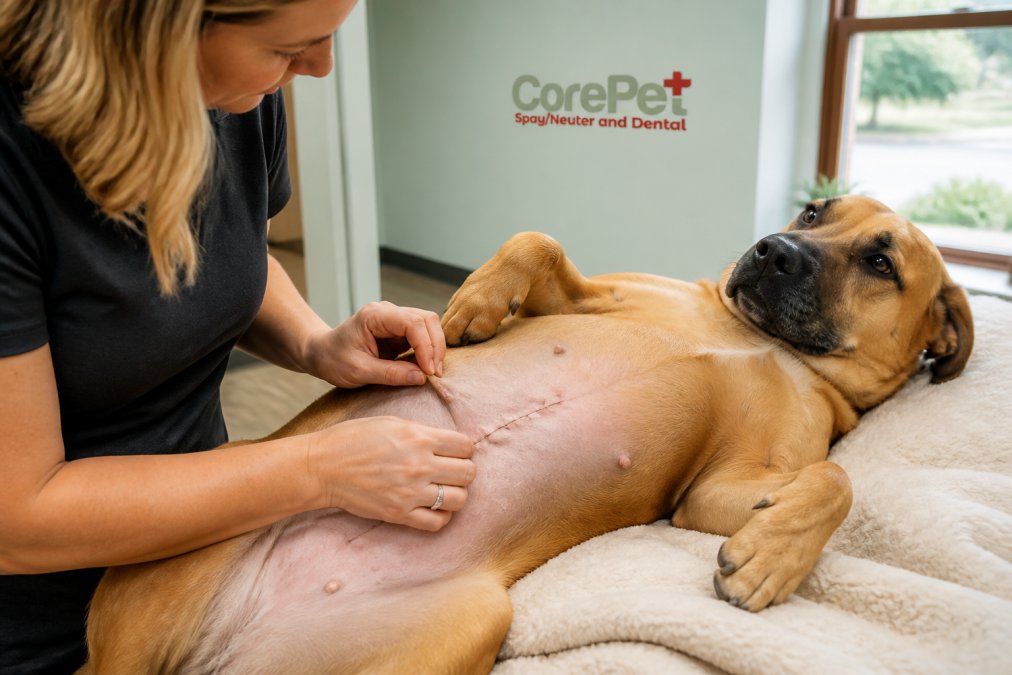
When to call the vet after dog surgery: any purulent discharge, foul odor, dehiscence, or tissue necrosis warrants a same-day call. Lethargy, anorexia, and fever suggest a systemic problem.
Never probe, squeeze, or apply ointments to an incision unless your veterinarian directs you to. Manipulating the wound can introduce bacteria and turn a minor concern into a dehiscence requiring surgical repair.
Bleeding that soaks through a bandage, or restarts after stopping, also warrants a call.
Preventing Dog Incision Licking and Scratching
Preventing dog incision licking and scratching is the most controllable factor in clean healing. An Elizabethan collar remains the most reliable barrier; a properly fitted cone extending past the nose prevents contact entirely.
Other strategies: restrict activity, provide a clean recovery space, use leash-only walks, use a recovery suit under supervision, and apply bitter deterrent sprays to bandages, never the incision. Anxious dogs lick more, so keep the recovery area quiet and ask your veterinarian about calming options.
If your dog is crate-trained, placing the crate where the family spends evenings reduces anxiety and unsupervised licking.
Monitoring for Systemic Symptoms and When to Contact Your Veterinarian
Systemic symptoms of a dog incision infection mean the problem has moved beyond the incision. Fever, lethargy, anorexia, and vomiting after surgery require prompt veterinary care. A dog that was bright and eating on day two but is withdrawn and refusing food on day four needs to be seen; pain control may be failing or an infection may be developing.
For owners in New Hampshire, knowing your options before an emergency saves time. Local emergency veterinary resources in Bedford, New Hampshire can assess a complication after hours, and your primary surgical provider should be contacted the next morning.
Ask yourself during daily checks: is this better, worse, or the same as yesterday? A healing incision improves; an infected one does not.
Seromas and hematomas can mimic infection as fluid-filled swelling beneath the incision. Only a veterinarian can distinguish them from an abscess, and antibiotics are not appropriate without a confirmed bacterial infection.
Understanding Incision Integrity and Sutures Versus Staples
Sutures and staples hold wound edges together while granulation tissue forms; incision integrity depends on edges staying aligned through early healing. Watch for loose or missing sutures, staples that pulled free, gaps between wound edges, and visible tissue beneath an opened incision.
A small gap at one end may be manageable with veterinary guidance; a fully open incision is an emergency. Do not close it yourself. Cover it with a clean, damp dressing and call your veterinarian immediately.
A Visual Identification Guide for Concerned Owners
Photographing the incision daily makes subtle changes obvious. Take the photo at the same time, in the same lighting, from the same angle. In your photo series, watch for erythema extending beyond the incision line, discharge turning cloudy, yellow, or green, increasing swelling, separating wound edges, and darkening tissue that may indicate necrosis. Bring your photo series to any recheck; a timeline of images helps your veterinarian judge whether a concern is progressing or resolving.
Frequently Asked Questions
How do I tell if my dog’s surgical wound is infected?
Look for increasing redness or warmth at the surgical site, swelling that gets worse instead of better, yellow or green discharge, a foul odor, or a gap opening between the wound edges. Your dog may also seem tired, refuse food, or run a fever. A little redness and swelling in the first day or two is normal, but symptoms that grow worse after 48 hours need a vet’s attention.
What does an infected dog incision look like compared to a healing one?
A healing incision looks clean and dry with the wound edges held together, mild pinkness, and a small amount of crusting. An infected one shows spreading erythema, purulent discharge, a foul odor, warmth to the touch, and possibly dehiscence where the edges pull apart. Photograph the site each day so you can compare changes over time rather than relying on memory.
How can I stop my dog from licking the incision?
An Elizabethan collar or a properly fitted recovery suit is the most reliable way to prevent licking and scratching. Keep the cone on whenever you cannot watch your dog directly, including overnight. Activity restriction also matters: short leash walks only, no running, jumping, or stairs. If your dog is anxious in a cone, ask your vet about alternatives before removing it.
A surgical incision that is healing well looks a little better every day. When that trend stalls or reverses, the window for simple intervention starts closing. CorePet provides focused surgical care for dogs, cats, and rabbits, with clear post-operative instructions and a team that answers recovery questions directly. Get started with CorePet and give your pet a calm, well-monitored recovery.