Table of Contents
- 1. Conduct a Thorough Expense Audit and Financial Analysis
- 2. Optimize Veterinary Inventory Management Best Practices
- 3. Automate Administrative Tasks and Remote Operations
- 4. Develop a Non-Profit Veterinary Clinic Budget Template and Cost Allocation Strategy
Last Updated: August 14, 2026
Veterinary nonprofits operate on razor-thin margins. A single unexpected equipment failure, supply shortage, or inefficient workflow can derail months of careful budgeting. Yet many clinics continue managing inventory by hand, paying full retail for medical supplies, and running administrative tasks that consume hours each week, all while serving animals that desperately need care.
The good news: reduce veterinary overhead doesn’t require cutting corners on quality or animal welfare. It requires strategy. This guide walks through seven concrete ways to lower costs while maintaining the exceptional care your nonprofit provides to dogs, cats, rabbits, and other animals in your community.
1. Conduct a Thorough Expense Audit and Financial Analysis
Start where most nonprofits hesitate to look: your actual spending. A comprehensive expense audit reveals where money really goes and where it’s leaking away unnoticed.
Categorize every expense into buckets: medical supplies, pharmaceuticals, facility costs, staffing, utilities, equipment maintenance, and administrative overhead. Pull the last 12 months of invoices and credit card statements. Many nonprofits discover they’re buying the same items from multiple vendors at wildly different prices, or paying for subscriptions they forgot they had. Understanding the relationship between service volume and expense helps you forecast accurately and identify the highest-impact areas for cost reduction. Document baseline numbers before making changes, this shows donors what efficiency gains you’ve actually achieved.
2. Optimize Veterinary Inventory Management Best Practices
Medical supply costs are often the largest controllable expense in a veterinary nonprofit. Yet many clinics order reactively, when something runs out, rather than strategically.
Implement a structured inventory system. Track what you use, how often, and at what cost. OpenVPM, a free open-source veterinary practice management system includes automated reorder points and lot tracking, eliminating both stockouts and overstocking.
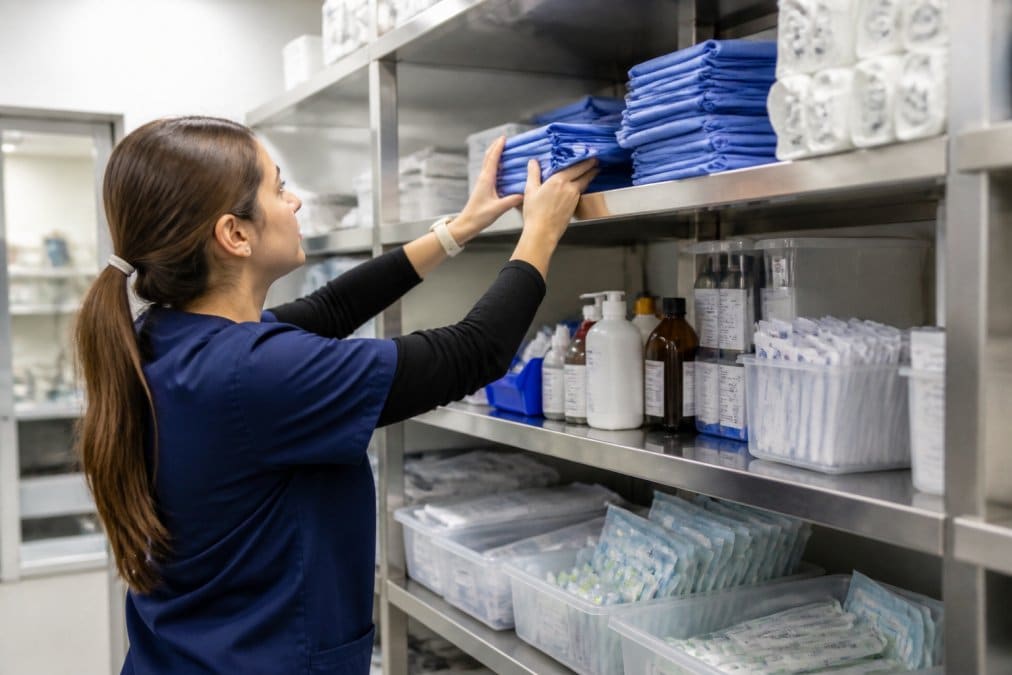
Negotiate with suppliers. Most vendors offer volume discounts if you consolidate orders. Consider Group Purchasing Organizations (GPOs) designed for nonprofits and small clinics, these membership-based organizations aggregate buying power across multiple facilities, unlocking wholesale pricing you couldn’t achieve alone. Project AnimalAid provides donated veterinary equipment and supplies free to animal welfare nonprofits. Set par levels for each item, the minimum quantity you maintain before reordering, and review quarterly as your service volume changes.
3. Automate Administrative Tasks and Remote Operations
Administrative work is invisible overhead. Staff spend hours scheduling appointments, sending reminders, processing invoices, and managing client communications, tasks that don’t directly serve animals but consume payroll budget.
Automation software reduces this burden. Shepherd Veterinary Software provides cloud-based practice management with automated invoicing and client communications. Weave offers integrated phone systems and two-way messaging that consolidate front-desk operations. For nonprofits with limited budgets, OpenVPM remains a strong option because it’s completely free and handles core administrative functions without license fees.
4. Develop a Non-Profit Veterinary Clinic Budget Template and Cost Allocation Strategy
Many nonprofits operate without a formal budget, making it impossible to track whether you’re on pace or heading toward deficit. A structured budget template forces clarity and helps funders understand your fiscal responsibility.
Create line items for each expense category, including both fixed costs (rent, insurance, base salaries) and variable costs (supplies, medications, utilities). Project revenue based on realistic case volume and average fees. Compare projections to actuals monthly.
| Expense Category | Monthly Budget | Actual Spending | Variance | Notes |
|---|---|---|---|---|
| Medical Supplies | $2,500 | $2,480 | -$20 | On track |
| Pharmaceuticals | $1,800 | $1,920 | +$120 | Higher case volume |
| Facility/Utilities | $1,200 | $1,200 | $0 | Stable |
| Staffing | $8,000 | $8,000 | $0 | Fixed salaries |
| Equipment Maintenance | $400 | $450 | +$50 | Quarterly service |
| Administrative Software | $300 | $300 | $0 | Locked rate |
| Total | $14,200 | $14,350 | +$150 | 1% over |
Review this monthly and investigate variances to adjust forecasts accordingly.
5. Use Technology for Grant Reporting and Donor Transparency
Nonprofits that clearly communicate their financial stewardship attract more funding. Grants 4 Animals provides grant writing services and resources for animal nonprofits helps you document outcomes and manage grant reporting. When you apply for the next grant, you’ll have data ready: how many animals served, cost per procedure, lives impacted per dollar spent.
6. Build a Sustainable Volunteer Program
Volunteers reduce labor costs while expanding capacity. Design a volunteer program with clear roles, training protocols, and expectations. Assign volunteers to specific tasks: administrative support, inventory management, client communication, or post-operative animal care.
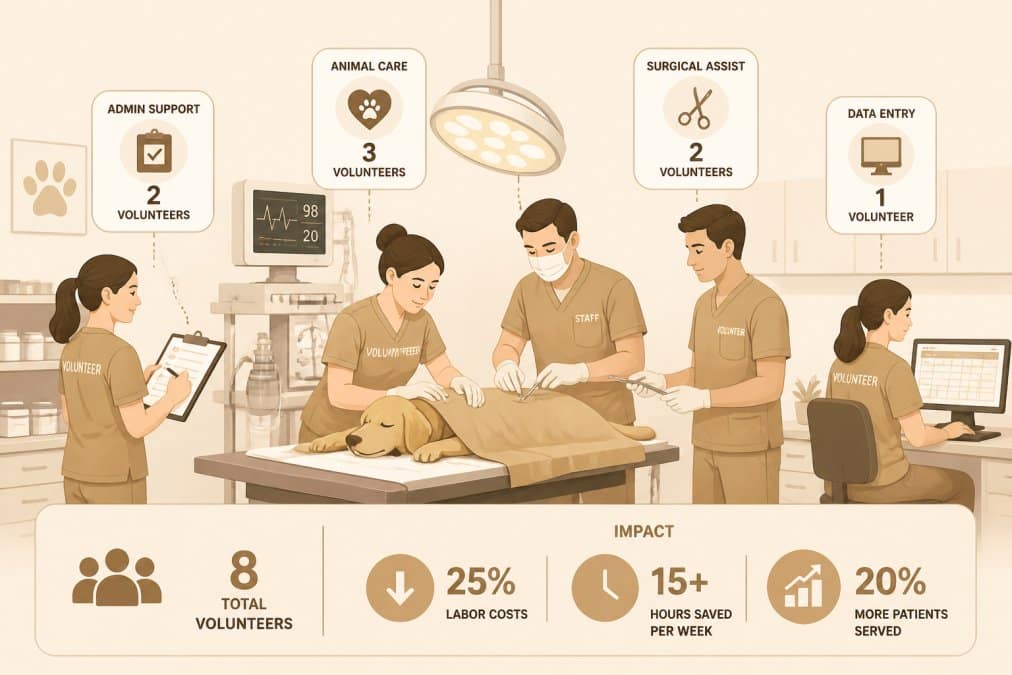
Track volunteer hours and document the value they create. If a volunteer logs 100 hours per month at an equivalent labor cost of $20/hour, that’s $2,000/month in labor cost offset. Recognize and retain volunteers through thank-you events, small stipends for training, or public acknowledgment in newsletters.
7. Implement Energy Efficiency for Clinical Facilities
Facility costs often feel fixed and unchangeable. Yet energy efficiency delivers measurable savings with upfront investment that pays for itself.
Audit your facility for quick wins: LED lighting (cuts electricity use by 75%), programmable thermostats (reduces heating/cooling during off-hours), and insulation improvements. Many utilities offer rebates for efficiency upgrades. Zone your HVAC system so you’re only conditioning occupied areas. Install motion sensors on lights in storage and break rooms. Track utility consumption monthly and benchmark against similar facilities.
Reducing veterinary overhead requires discipline and data, not sacrifice. Start with an expense audit to see where money actually goes. Then systematically address the highest-impact areas: inventory, automation, staffing efficiency, and facility costs.
For nonprofits in Bedford, New Hampshire seeking surgical support for animals in your care, CorePet offers a focused alternative to traditional full-service veterinary clinics. By concentrating exclusively on Spay Neuter Dental procedures, the surgeries with the greatest impact on animal health, CorePet delivers exceptional outcomes at reasonable costs. This focused approach means your nonprofit gets experienced surgical care without paying for services you don’t need. Book an Appointment with CorePet to discuss how surgical partnerships can fit into your nonprofit’s financial plan.
Frequently Asked Questions
What is the 33% rule for non-profits and how does it apply to veterinary overhead?
The 33% rule suggests that non-profits should aim to spend approximately one-third of their budget on overhead and administrative costs, with the remaining two-thirds directed toward program services. For veterinary non-profits, this means keeping overhead, including facility costs, staff salaries, utilities, and administrative expenses, at or below 33% of total operating budget. This benchmark helps ensure fiscal responsibility and maximizes resources directed toward animal care. However, veterinary clinics may operate differently based on mission and service model, so tracking your actual overhead ratio is essential.
How can animal shelters reduce medical supply expenses?
Animal shelters can reduce medical supply costs through several strategies: implement inventory tracking to prevent waste and overstocking, negotiate volume discounts with suppliers, join group purchasing organizations designed for non-profits, source donated supplies through programs like Project AnimalAid, and establish relationships with local veterinary practices for bulk purchasing. Additionally, training staff on proper supply handling reduces breakage and expiration. Using veterinary inventory management software helps automate reordering and identifies cost-saving opportunities based on usage patterns.
What is the most effective way to lower veterinary clinic overhead?
The most effective approach combines multiple strategies: conduct a detailed expense audit to identify where money is spent, automate administrative tasks using practice management software to reduce labor costs, optimize inventory to minimize waste, reduce facility expenses through energy efficiency and space optimization, and engage volunteers for non-clinical support roles. The 80/20 rule applies here, focus on the 20% of expenses that represent 80% of your overhead. For veterinary non-profits, medical supplies and facility costs typically represent the largest controllable expenses, making inventory optimization and energy efficiency the highest-impact areas to address first.
How does the 80/20 rule apply to reducing veterinary non-profit overhead?
The 80/20 rule (Pareto principle) suggests that 80% of your overhead costs likely come from 20% of your expense categories. For veterinary non-profits, this typically means medical supplies, pharmaceuticals, facility maintenance, and staffing represent the bulk of overhead. By identifying and focusing on these high-impact areas first, you achieve maximum cost reduction with minimal effort. Conduct an expense audit to pinpoint your specific 20%, then prioritize solutions in those areas, such as inventory optimization for supplies or energy audits for facilities, before addressing smaller expenses.
Can veterinary non-profits access tax-exempt benefits for medical supplies?
Veterinary non-profits with 501(c)(3) status may qualify for tax exemptions on purchases, depending on state and local regulations. Some suppliers offer non-profit discounts or donate supplies directly. Additionally, organizations like Project AnimalAid provide free veterinary equipment and supplies to qualifying animal welfare non-profits. Check with your state's non-profit association and explore group purchasing organizations that negotiate volume discounts specifically for non-profit clinics. Consult a tax professional to understand your specific eligibility and ensure compliance with regulations.
This article was written using GrandRanker