Table of Contents
- Pet Dental Cleaning vs At Home Brushing: Why Both Matter
- Signs of Periodontal Disease in Dogs You Should Not Ignore
- What Happens During a Pet Dental Cleaning Procedure
- How to Brush Dog Teeth at Home: A Step-by-Step Guide
- Choosing the Right Approach for Your Pet
- Frequently Asked Questions
Last Updated: September 5, 2026
Pet Dental Cleaning vs At Home Brushing: Why Both Matter
Pet dental cleaning vs at home brushing is not about choosing one over the other. A complete dental health routine depends on both.
Professional cleanings remove hardened tartar and bacteria below the gumline, while brushing prevents new plaque from mineralizing into calculus between visits. Brushing alone cannot reverse existing disease, and cleanings lose their benefit without home maintenance.
Signs of Periodontal Disease in Dogs You Should Not Ignore
Periodontal disease is the most common dental condition in adult dogs, yet many owners miss early warning signs. Gingivitis causes red, swollen gums that may bleed during brushing. As plaque spreads below the gumline, periodontitis damages the tissues holding teeth in place.
Watch for these indicators that your dog needs a professional oral examination:
- Persistent halitosis, or bad breath, that does not improve with brushing
- Visible yellow or brown calculus along the tooth surfaces
- Gums that bleed easily or recede away from the teeth
- Reluctance to eat, chewing on one side, or dropping food
- Loose teeth, pawing at the mouth, or visible tooth resorption
Many owners dismiss bad breath as normal “dog breath.” In reality, halitosis is often the first sign of active oral infection. Left untreated, oral bacteria enter the bloodstream and can affect the heart, liver, and kidneys. What begins as gum inflammation can become a systemic health problem.
What Happens During a Pet Dental Cleaning Procedure
A professional pet dental cleaning, also called dental prophylaxis, is performed under general anesthesia. The steps go far beyond any at home routine.
The process includes pre-anesthetic blood work to confirm your pet can safely handle anesthesia. The veterinarian performs a complete oral examination, probing each tooth for pockets where bacteria have separated the gum from the tooth. Dental radiographs reveal problems below the surface.
Scaling and polishing remove plaque and tartar above and below the gumline. Subgingival cleaning targets the area beneath the gums where the most destructive bacteria hide. Teeth diseased beyond repair may require extraction.
Anesthesia is not optional for a thorough dental cleaning. It allows the veterinarian to examine the entire mouth, take radiographs, and clean below the gumline without causing pain or stress. Anesthesia-free cleanings only remove visible tartar above the gumline and can leave disease untreated while giving owners a false sense of security.
How to Brush Dog Teeth at Home: A Step-by-Step Guide
Daily brushing is the single most effective way to slow plaque accumulation between professional cleanings. The goal is to extend the benefits of each cleaning.
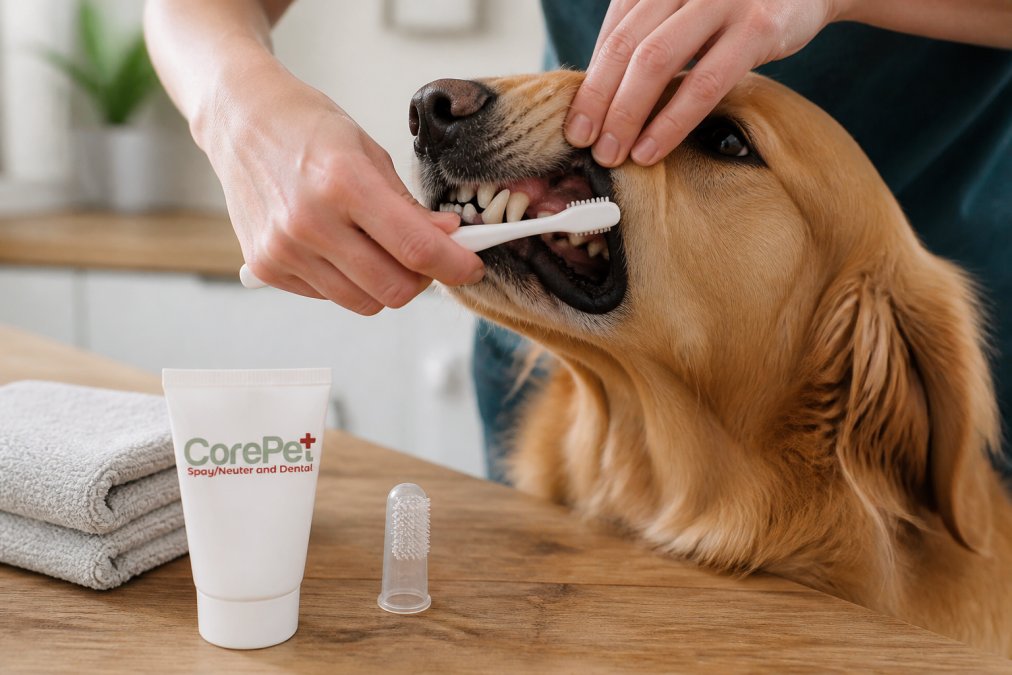
Step 1: Choose the right tools. Use a soft-bristled toothbrush designed for dogs or a finger brush for smaller pets. Always use enzymatic toothpaste made for pets; human toothpaste contains ingredients that can upset your dog’s stomach.
Step 2: Desensitize gradually. Start by letting your dog taste the toothpaste from your finger. Then lift the lip briefly and touch the teeth and gums, rewarding calm behavior. Repeat for several days before introducing the brush.
Step 3: Establish a routine. Choose a time when your dog is relaxed, such as after a walk, and use the same spot each day. Keep sessions short, building from a few seconds to one to two minutes.
Step 4: Use proper technique. Hold the brush at a 45-degree angle toward the gumline. Focus on the outer surfaces of the teeth, where plaque accumulates most heavily, using small circular motions from the back teeth forward.
Step 5: Be consistent. Daily brushing is the gold standard, but several times per week still provides meaningful benefit. A routine that happens three times per week outperforms one that happens once a month.
| Approach | What It Removes | Frequency | Best For |
|---|---|---|---|
| Professional cleaning | Tartar, subgingival bacteria, diseased teeth | Every 6-12 months as recommended | Established disease, thorough examination |
| At home brushing | Fresh plaque before it hardens | Daily to several times weekly | Prevention between cleanings |
| Dental chews and rinses | Surface debris, minor plaque | Daily supplemental use | Supporting, not replacing, brushing |
Introduce brushing when your dog is a puppy if possible. Adult dogs can learn, but the process takes more patience. Start with the desensitization steps and progress slowly. Many dogs come to see brushing as a bonding activity, especially when it consistently ends with a reward.
Choosing the Right Approach for Your Pet
The most effective dental care combines professional cleanings with consistent home care. Professional cleanings address existing disease and give you a clean slate, while daily brushing prevents the rapid return of plaque and tartar. For pet owners searching for a pet dental cleaning near me in New Hampshire, CorePet offers a dedicated surgery center focusing on dental procedures for dogs, cats, and rabbits.
Breed matters when planning dental care. Small breeds and brachycephalic breeds with flat faces often experience crowded teeth, which trap food and accelerate plaque accumulation. These dogs may need professional cleanings more frequently than larger breeds.
Brushing at home and professional dental cleaning are not competing options. They are complementary layers of the same preventative care strategy. Professional cleaning treats what brushing cannot, and brushing preserves what professional cleaning achieves. Together, they give your pet the best chance at a healthy mouth and a longer, healthier life.
Keeping your pet’s teeth healthy requires a commitment to both professional care and daily maintenance. CorePet is a locally owned surgery center in New Hampshire that focuses on spay, neuter, and dental procedures. From pre-anesthetic screening to postoperative care, every step is designed around your pet’s safety and comfort. Book an appointment with CorePet and give your pet the dental care they deserve.
Frequently Asked Questions
Are professional pet dental cleanings really necessary if I brush my dog’s teeth?
Yes. Daily brushing removes soft plaque from tooth surfaces, but it cannot remove hardened tartar below the gumline. A professional pet dental cleaning procedure uses anesthesia so the veterinarian can perform a complete oral examination, take dental radiographs, and clean subgingival areas where periodontal disease starts. Think of brushing as your daily maintenance and professional cleanings as the deep reset that protects your dog’s systemic health.
How often should my pet receive a professional dental assessment?
Most veterinarians recommend an annual oral examination and professional cleaning. Some smaller breeds are prone to quicker tartar buildup and may need cleanings every six months. Your vet will assess your pet’s individual risk based on age, breed, and the condition of their teeth and gums. Watch for signs of periodontal disease in dogs, such as halitosis, red gums, or difficulty eating, and schedule an assessment sooner if these appear.
What is the most effective way to maintain my pet’s oral health at home?
Daily brushing with a soft-bristled toothbrush and enzymatic toothpaste made for pets is the gold standard. Dental chews and wipes can supplement brushing, but they do not replace the mechanical action of brushing. Start slowly, use positive reinforcement, and pair your at-home routine with regular professional cleanings. This combined approach is what actually prevents gum recession and tooth loss.