Table of Contents
- Is Professional Pet Dental Cleaning Worth It? The Short Answer
- Signs of Dental Disease in Pets You Should Never Ignore
- What Happens During a Professional Pet Dental Cleaning?
- Anesthesia-Free Pet Dental Cleaning Risks: Why Vets Warn Against It
- Pet Dental Cleaning Cost: What to Expect and How to Plan
- How to Brush Dog Teeth and Build a Daily Oral Care Routine
- How to Prepare Your Pet for a Professional Dental Cleaning
- Is Professional Pet Dental Cleaning Worth It? Our Final Verdict
Last Updated: June 8, 2026
Is Professional Pet Dental Cleaning Worth It? The Short Answer
Periodontal disease affects the majority of dogs and cats by middle age, making dental health one of the most overlooked aspects of routine veterinary care. The answer is yes, and the reasoning goes well beyond fresh breath. At CorePet, we see firsthand how untreated oral disease progresses from mild gingivitis to systemic infection affecting the heart, liver, and kidneys. This guide covers what Manchester pet owners need to know before booking a dental appointment: what the procedure involves, what it costs, and how to build a home routine that extends results between visits.
Most guides treat professional dental cleaning as a cosmetic luxury rather than a medical necessity. Plaque hardens into tartar within days, bacteria colonize below the gumline, and by the time bad breath is noticeable, disease is already well established.
According to the American Veterinary Dental College’s guidance on periodontal disease, periodontal disease is the most common clinical condition in adult dogs and cats, with signs present in most pets by age three. This isn’t an optional upgrade, it’s preventative care.
Signs of Dental Disease in Pets You Should Never Ignore
Most pet owners notice halitosis first, but bad breath is a late indicator. By the time you can smell the problem, bacteria have likely been accumulating below the gumline for months.
Early Warning Signs vs. Advanced Periodontal Disease
Early signs of dental disease are subtle and easy to dismiss. Watch for:
- Reluctance to chew on one side of the mouth
- Dropping food while eating
- Pawing at the face or mouth
- Mild redness along the gumline (early gingivitis)
- Slight discoloration or yellowing on tooth surfaces (plaque and tartar buildup)
Advanced periodontal disease presents far more aggressively. Gum recession, tooth mobility, visible root exposure, and significant discomfort indicate the condition has progressed beyond routine cleaning. At this stage, extraction often becomes necessary, and systemic risks, including bacteria entering the bloodstream and affecting organ function, become clinically significant. Dental disease progresses silently; by the time a dog shows behavioral changes around eating, the underlying damage is already substantial.
Breed-Specific Dental Predispositions: Which Dogs Are at Higher Risk?
Brachycephalic breeds face a structurally higher risk. Dogs like Bulldogs, Pugs, Shih Tzus, and Boston Terriers have compressed jaw structures that cause teeth to crowd and trap plaque in areas nearly impossible to clean at home. Toy breeds, Chihuahuas, Yorkshire Terriers, Miniature Poodles, similarly develop tartar rapidly due to the ratio of tooth size to jaw length. Greyhounds and Whippets are another high-risk group, genetically predisposed to thin enamel and accelerated decay despite their athletic builds.
If your dog falls into any of these categories, annual professional cleaning starting earlier than typical is appropriate preventative care.
Owners of brachycephalic breeds often underestimate dental risk because their dogs eat normally. Tooth crowding creates hidden pockets where bacteria accumulate undetected. By the time symptoms appear, multiple teeth may require extraction.
What Happens During a Professional Pet Dental Cleaning?
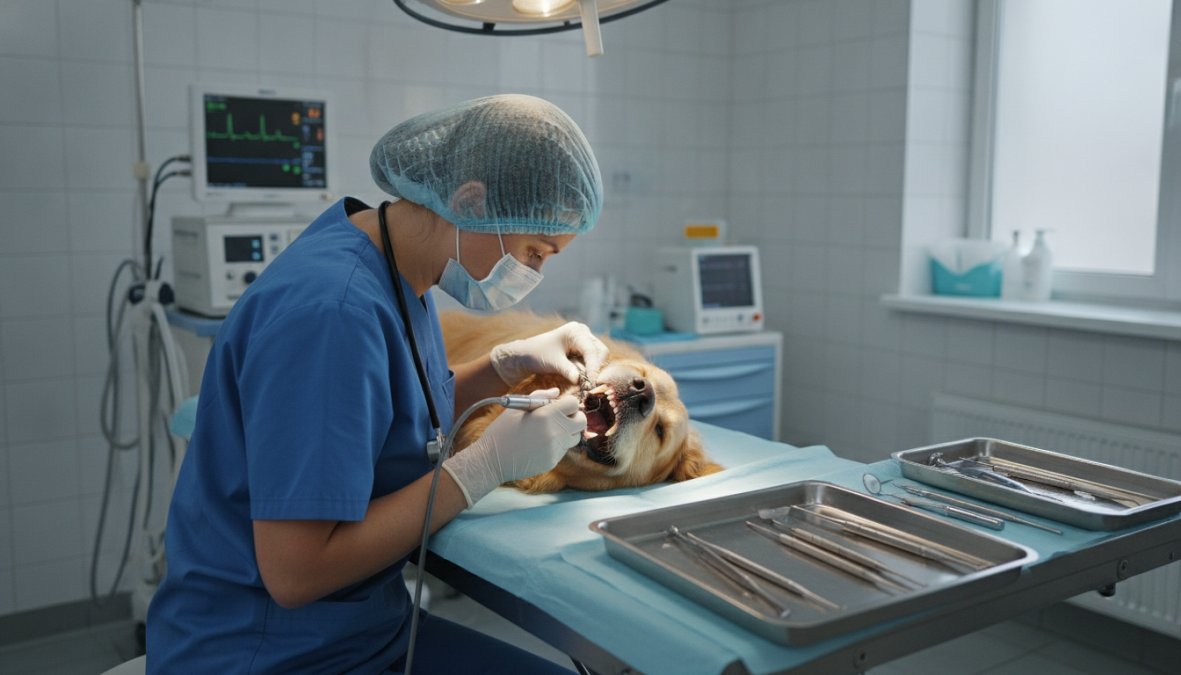
A professional pet dental cleaning is a multi-stage veterinary procedure performed under general anesthesia that includes oral examination, scaling, root planing, polishing, and dental radiographs. This is not comparable to a grooming appointment.
The Role of Anesthesia and Pre-Anesthetic Blood Work
Anesthesia is non-negotiable. A pet that is awake cannot hold still for subgingival scaling, cannot tolerate dental radiographs, and cannot be safely protected from inhaling water and debris during the procedure.
Pre-anesthetic blood work evaluates kidney health, liver function, and blood cell counts to determine whether a pet can safely metabolize anesthetic agents, a critical step for older pets or those with known conditions. A trained veterinary technician monitors heart rate, respiratory rate, blood oxygen, and blood pressure continuously throughout the procedure. This is what separates a safe routine procedure from a risky one.
Scaling, Root Planing, and Dental Radiographs Explained
Scaling is the mechanical removal of plaque and tartar from tooth surfaces above and below the gumline. Ultrasonic scalers use high-frequency vibration and water irrigation to break apart calculus without damaging enamel.
Root planing smooths the root surface after scaling to remove remaining bacterial deposits and encourage healthy gum reattachment, essential for teeth with significant pocket depth.
Dental radiographs reveal what no visual exam can: bone loss, tooth root abscesses, resorptive lesions, and impacted teeth. Many veterinarians estimate that a significant proportion of dental pathology is invisible without X-rays. Skipping this step means treating only the surface of the problem.
After scaling and radiographs, teeth are polished to remove micro-abrasions that would otherwise accelerate future plaque adhesion.
Anesthesia-Free Pet Dental Cleaning Risks: Why Vets Warn Against It
Anesthesia-free dental cleaning is one of the most misleading services marketed to pet owners. As documented in [the American Animal Hospital Association’s dental care(/blog/6-signs-your-pet-needs-urgent-dental-care-3/) guidelines | aaha.org], anesthesia-free procedures address only the visible crown surface, leaving subgingival disease completely untreated.
The core problem: the part of dental disease that causes systemic infection, bone loss, and tooth loss lives below the gumline. Scraping visible tartar from the crown while bacteria continue to colonize root pockets is cosmetic intervention, not medical treatment. The tooth looks cleaner; the disease progresses uninterrupted. Scaling on an awake animal is also inherently stressful, creates sharp enamel micro-fractures when the animal moves, and poses a genuine aspiration risk. There is no safe way to perform dental radiographs on an unsedated pet.
The appeal is understandable, it’s cheaper and feels less invasive. But owners who choose this route often spend more money later addressing advanced periodontal disease that was never actually treated.
Anesthesia-free dental cleaning addresses only visible tartar on the crown surface. It cannot treat subgingival disease, cannot include dental radiographs, and provides no protection against the systemic consequences of untreated periodontal disease.
Pet Dental Cleaning Cost: What to Expect and How to Plan
Pet dental cleaning cost is the most common reason owners delay the procedure. Understanding what drives the price makes it easier to plan, and to recognize when a quote is appropriate versus when something is being left out.
Factors That Influence the Final Price
Several variables affect the final cost of a professional dental cleaning:
| Factor | Lower Cost Scenario | Higher Cost Scenario |
|---|---|---|
| Pet size | Small dog or cat | Large breed dog |
| Disease severity | Routine cleaning, healthy gums | Advanced periodontal disease |
| Extractions needed | None | Multiple teeth |
| Dental radiographs | Included in base price | Billed separately |
| Pre-anesthetic blood work | Included | Add-on fee |
| Geographic location | Lower cost-of-living areas | Urban/metro areas |
| Facility type | Dedicated dental/surgery center | Specialty hospital |
CorePet’s transparent pricing model is designed to make essential dental care accessible for Manchester, New Hampshire pet owners. Because CorePet focuses exclusively on dental and spay/neuter procedures, the team’s efficiency with these specific cases translates directly into cost savings for clients. A common mistake is comparing base-price quotes without confirming what’s included, a quote that excludes radiographs, blood work, or potential extractions will almost always look cheaper upfront and cost more in total.
Does Pet Insurance Cover Dental Cleanings? A Practical Breakdown
Pet insurance coverage for dental procedures varies significantly by policy type. Accident-and-illness plans frequently exclude routine cleanings as preventative care. Wellness add-ons often cover routine cleanings up to a specified annual limit. Dental illness coverage is a separate category, policies that include it cover treatment for periodontal disease, tooth fractures, and abscesses, but typically only when documented as a disease state rather than routine maintenance.
Before your pet’s next dental appointment, review your policy for these specific terms:
- Does the policy include a wellness rider or preventative care add-on?
- Is periodontal disease classified as a covered dental illness?
- Are pre-anesthetic blood work and dental radiographs covered as diagnostic procedures?
- Is there an annual dental benefit cap?
- Does the policy require a waiting period before dental coverage activates?
According to the North American Pet Health Insurance Association’s annual industry report, many owners don’t review dental coverage specifics until they’re already at the vet. Review your policy before you need it, not after.
How to Brush Dog Teeth and Build a Daily Oral Care Routine
Knowing how to brush dog teeth properly is the single most effective thing an owner can do between professional cleanings. Daily brushing disrupts plaque before it mineralizes into tartar, the only stage at which home care can actually remove it.
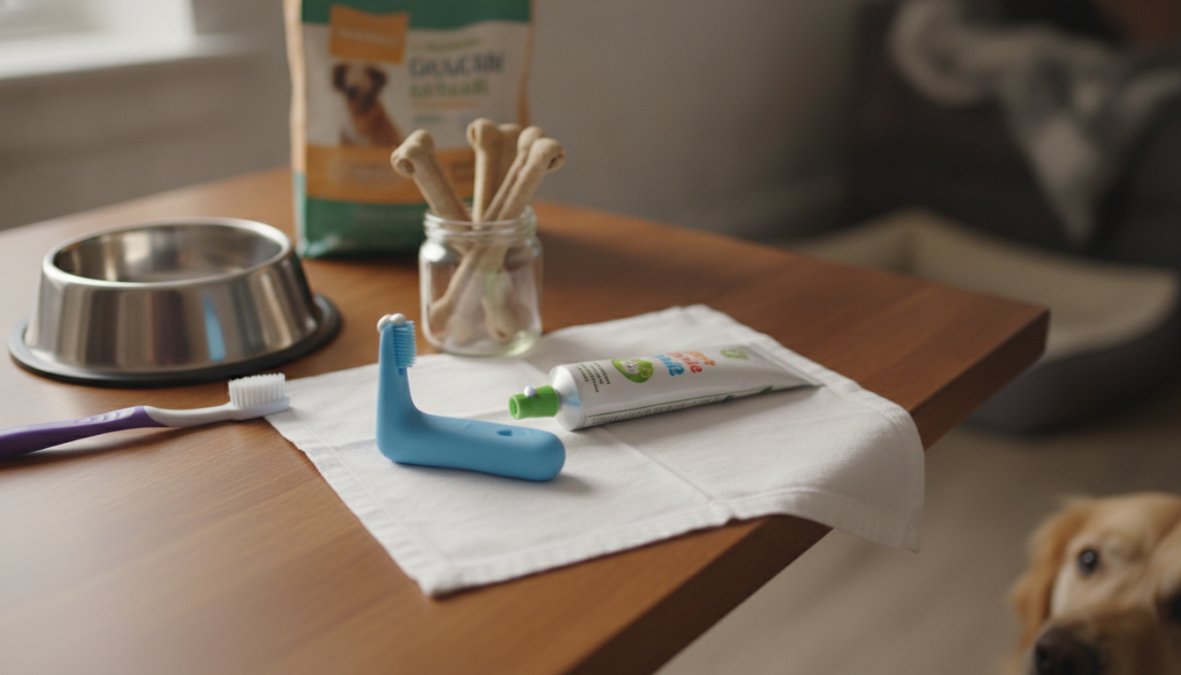
- Start with a pet-specific enzymatic toothpaste, never human toothpaste, which contains xylitol and fluoride at concentrations toxic to dogs.
- Use a finger brush for initial training. Most dogs accept this more readily than a long-handled brush.
- Focus on the outer surfaces of the upper back teeth, where tartar accumulates fastest due to proximity to salivary glands.
- Use small circular motions along the gumline.
- Keep sessions short initially (15-30 seconds) and build duration gradually over two to four weeks.
- End every session with a positive reinforcement reward to build a cooperative association.
At-Home Care vs. Professional Cleaning: Do You Need Both?
The answer is unambiguously yes. Home brushing removes soft plaque from accessible crown surfaces but cannot reach below the gumline, remove established tartar, or identify early periodontal pockets. Professional cleaning addresses all of these, but its effects diminish as plaque reaccumulates.
Dental chews carrying the Veterinary Oral Health Council seal, such as Greenies, provide a supplemental mechanical cleaning effect and are a useful addition to a home routine, but not a replacement for brushing or professional care.
The practical framework: daily brushing plus VOHC-approved dental chews reduces plaque accumulation between visits; annual professional cleaning addresses what home care cannot. Neither works as well without the other.
For dogs that resist brushing, dental water additives approved by the Veterinary Oral Health Council offer a low-resistance way to reduce bacterial load daily. They won’t replace brushing, but they’re meaningfully better than nothing for resistant patients.
How to Prepare Your Pet for a Professional Dental Cleaning
Preparation starts several days before the appointment. Knowing what to expect reduces stress for both pet and owner.
Before the appointment:
- Confirm fasting requirements. Most practices require no food after midnight, with water permitted until a specified morning cutoff.
- Complete any required pre-anesthetic blood work, some practices run this at the appointment; others require it in advance.
- Disclose all current medications, supplements, and known health conditions, as some affect anesthetic protocols.
- Arrange transportation home; your pet will be recovering from anesthesia and should not be left unattended immediately after discharge.
Day of the procedure:
- Arrive at the scheduled drop-off time to avoid rushing the intake process.
- Confirm how you’ll be contacted if radiographs reveal the need for extractions or additional treatment, and whether verbal consent is required before proceeding.
Post-procedure care:
- Expect mild grogginess for several hours after discharge, normal following anesthesia.
- Offer soft food for 24-48 hours if extractions were performed.
- Resume brushing gently once gum tissue has healed, typically within a week for routine cleanings.
- Schedule the next cleaning based on your veterinarian’s recommendation rather than waiting for symptoms to return.
For pet owners near Manchester, New Hampshire, a dedicated dental facility means the team performing the procedure focuses exclusively on these cases every day, specialization that matters for both safety and efficiency.
Is Professional Pet Dental Cleaning Worth It? Our Final Verdict
Professional pet dental cleaning is worth it. Periodontal disease is progressive, largely invisible until advanced, and directly connected to systemic conditions affecting cardiac, hepatic, and renal function. The cost of treatment at an advanced stage, including multiple extractions and management of secondary disease, consistently exceeds the cost of annual preventative cleaning by a significant margin.
As outlined in Cornell University College of Veterinary Medicine’s dental health resources, preventative dental care is among the highest-impact interventions available in routine veterinary medicine. The real question isn’t whether to pursue professional dental care, it’s how to make it financially manageable and how to extend results with a consistent home routine.
Annual professional cleaning, daily brushing, and VOHC-approved supplemental products form a complete strategy. Any one alone is insufficient. Together, they protect both quality of life and longevity.
Dental disease is one of the most preventable conditions in companion animals, yet it remains one of the most undertreated. CorePet’s Manchester, New Hampshire surgery center specializes exclusively in dental procedures and spay/neuter surgeries, which means every dental cleaning is performed by a team that handles these cases daily with modern equipment and individualized care protocols. Visit the CorePet pricing page to review current rates, then book an appointment to give your pet the oral health care they need.
Frequently Asked Questions
How often do dogs and cats need professional dental cleaning?
Most veterinarians recommend a professional dental cleaning once a year for the average adult dog or cat. However, small or brachycephalic breeds prone to crowded teeth and faster tartar buildup may need cleanings every six months. Senior pets and those with a history of periodontal disease may also require more frequent visits. Your veterinarian can assess your pet's individual oral health during a routine wellness exam and recommend the right schedule.
What are the risks of not getting my pet's teeth cleaned?
Skipping professional dental cleanings allows plaque and tartar to accumulate, which leads to gingivitis and eventually periodontal disease. Untreated dental disease causes chronic discomfort, tooth loss, and persistent bad breath. More seriously, oral bacteria can enter the bloodstream and contribute to systemic infection affecting heart health, liver health, and kidney health. What starts as a preventable oral issue can become a costly, life-threatening condition, making routine professional cleaning a sound long-term investment.
How much does professional pet dental cleaning cost, and does pet insurance help?
Pet dental cleaning cost varies based on location, pet size, the severity of tartar buildup, and whether dental radiographs or extractions are needed. Many wellness or preventative care add-ons to pet insurance policies do cover routine dental cleanings, while standard accident-and-illness plans may cover cleanings required to treat diagnosed periodontal disease. Reviewing your policy's dental coverage before scheduling can significantly reduce out-of-pocket expenses. CorePet provides transparent pricing on its website to help owners plan ahead.
Is anesthesia-free pet dental cleaning a safe alternative?
Anesthesia-free dental cleaning is widely considered inadequate and potentially harmful by veterinary professionals. Without anesthesia, a veterinarian cannot safely scale below the gumline where bacteria and tartar cause the most damage, take dental radiographs, or probe for hidden periodontal pockets. The procedure also causes significant stress and discomfort to the pet. A surface-only cleaning may make teeth look cleaner without addressing the underlying oral health issues, giving owners a false sense of security.
Can brushing my dog's teeth at home replace professional cleanings?
Daily brushing is the single most effective at-home preventative care habit you can build, and it meaningfully slows plaque and tartar accumulation. However, it cannot replace professional dental cleaning entirely. Once tartar hardens on the tooth surface and below the gumline, only professional scaling tools can safely remove it. Think of home brushing as maintenance between appointments, using a pet-safe toothpaste, a finger brush, and dental chews like Greenies alongside annual vet cleanings gives your pet the best oral health outcome.
At what age should I start professional dental cleanings for my pet?
Most veterinarians recommend scheduling a first professional dental cleaning by the time a pet is two to three years old, as significant tartar buildup can begin as early as age one in some breeds. Starting cleanings early helps prevent the progression to periodontal disease and makes each subsequent procedure simpler and lower-risk. Your veterinarian will typically evaluate your pet's teeth during every wellness exam and advise when the first cleaning is clinically appropriate.
This article was written using GrandRanker