Table of Contents
-
6 Signs Your Pet Needs Urgent Dental Care
-
Stages of Periodontal Disease in Pets: What Happens If You Wait
-
When to Schedule a Veterinary Dental Appointment in Manchester, NH
Last Updated: May 30, 2026
Periodontal disease affects the majority of dogs and cats by the time they reach age three, yet most pet owners don’t recognize the warning signs until the damage is already severe. Knowing the 6 signs your pet needs urgent dental care can be the difference between a routine cleaning and a painful tooth extraction. This guide from CorePet covers each sign in plain terms, explains what’s happening beneath the gumline, and tells you exactly when to pick up the phone and book an appointment. Below, we’ll also walk you through a home screening routine, breed-specific risks most guides skip entirely, and what dental disease actually costs your pet’s long-term health.
Here’s what most owners get wrong: they assume bad breath is normal for dogs and cats. It isn’t. Halitosis is a clinical sign, not a personality quirk. By the time you can smell periodontal disease from across the room, the infection has often been progressing for months.
Why Dental Health Is More Than Just Fresh Breath
Oral health in pets is a systemic issue, not a cosmetic one. Periodontal disease is a progressive bacterial infection of the structures supporting the teeth, including the gums, periodontal ligament, and alveolar bone. Left untreated, the bacteria responsible for gum inflammation don’t stay in the mouth. They enter the bloodstream and travel to major organs.
According to the American Veterinary Medical Association’s pet dental health resources, dental disease is one of the most commonly diagnosed health problems in companion animals. The AVMA connects advanced periodontitis to increased risk of kidney, liver, and heart complications in dogs and cats.
This is the part that changes everything: a pet with visibly dirty teeth isn’t just dealing with a cosmetic issue. The subgingival bacteria, those living below the gumline where no toothbrush reaches, are actively producing toxins. Those toxins drive systemic infection. Veterinary dentistry exists precisely because oral hygiene is inseparable from overall pet wellness.
Professional cleaning, which includes dental scaling, polishing, and dental radiographs under anesthesia, removes calculus that home care cannot touch. Anesthesia-free dental cleaning, while appealing to owners, only addresses visible surfaces and misses the subgingival disease that causes the most damage. That distinction matters enormously.
Watch OutAnesthesia-free dental cleaning removes visible tartar but cannot address subgingival disease. Pets that receive only anesthesia-free cleanings often have advanced periodontitis discovered at their first proper oral exam under anesthesia. Do not substitute one for the other.
6 Signs Your Pet Needs Urgent Dental Care
Recognizing the 6 signs your pet needs urgent dental care early gives you the best chance of preserving teeth and preventing systemic complications. These signs exist on a spectrum from early to advanced disease, but any one of them warrants a veterinary oral exam.
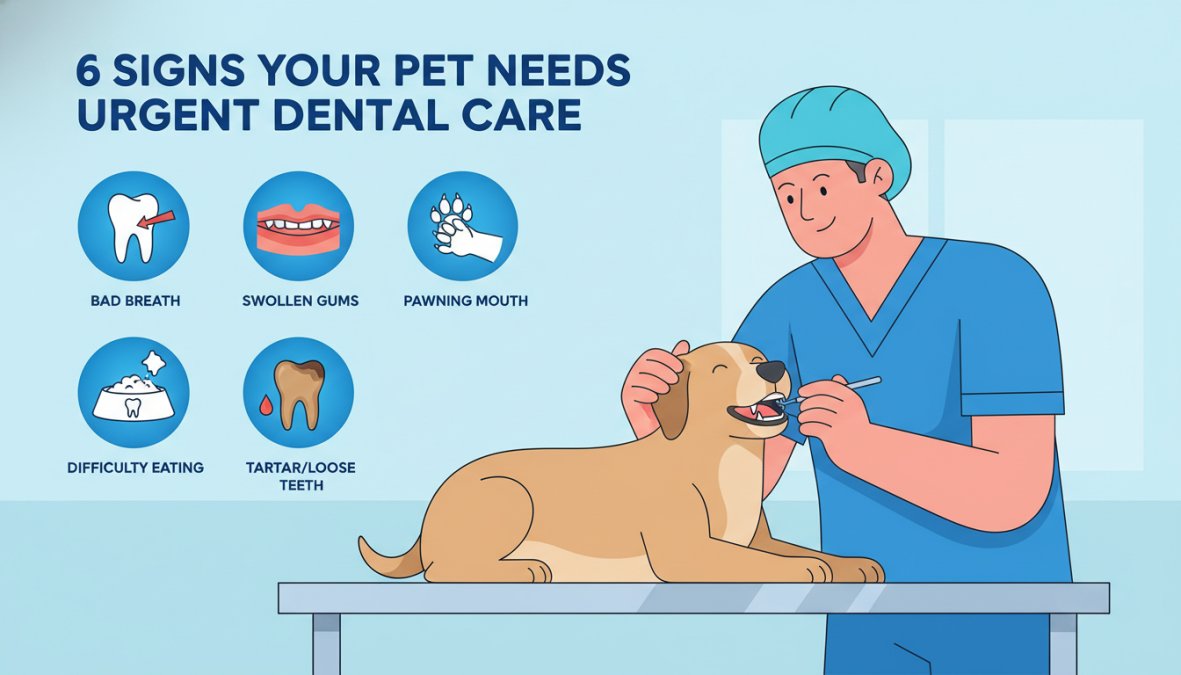
Close-up of a veterinarian in blue scrubs gently lifting the lip of a medium-sized dog to inspect its teeth and gums during an oral exam on a stainless steel table under bright clinical lighting in a clean veterinary clinic
Sign 1: Persistent Bad Breath (Halitosis)
Halitosis in pets is caused by volatile sulfur compounds produced by oral bacteria, not by what your pet ate for dinner. A mild, meaty smell after eating is normal. A persistent, foul odor that doesn’t clear up is not. When the smell is strong enough to notice from a few feet away, or when it has a distinctly sour or rotting quality, bacterial load in the mouth is already significant.
The smell intensifies as periodontal disease advances because the bacteria responsible for tissue destruction produce sulfur compounds as metabolic byproducts. Gingivitis, the earliest reversible stage, already produces detectable halitosis. By the time the odor is severe, the disease has often progressed to periodontitis with bone loss.
A common mistake is masking the odor with dental treats without addressing the underlying cause. Treats help with maintenance, but they cannot reverse active infection.
Sign 2: Visible Tartar, Plaque, or Discolored Teeth
Plaque is a soft, sticky film of bacteria that forms on teeth within hours of eating. When plaque mineralizes, it becomes tartar, also called calculus, which bonds to the tooth surface and cannot be removed by brushing. Tartar appears as yellow, brown, or gray deposits, most visible on the upper back teeth near the cheek.
Discoloration matters beyond aesthetics. A tooth that has turned pink, gray, or purple has suffered internal bleeding, which usually indicates pulp damage. These teeth are painful and frequently require extraction. A purple or gray tooth that looks intact is not healthy.
If you can see heavy calculus on your pet’s teeth without lifting the lip very far, the subgingival buildup is almost certainly worse than what’s visible.
Sign 3: Red, Swollen, or Bleeding Gums (Gingivitis)
Healthy gum tissue is pale pink and firm, with a clearly defined edge where it meets the tooth. Red, puffy, or inflamed gums indicate gingivitis, the earliest clinical stage of periodontal disease. Gums that bleed when your pet chews a toy or when you attempt to brush are already compromised.
Gingivitis is the only stage of periodontal disease that is fully reversible with professional cleaning and consistent home care. Once the inflammation progresses to periodontitis, with loss of the periodontal ligament and alveolar bone, the damage is permanent. Catching red gums early is genuinely time-sensitive.
Pro TipCheck your pet’s gum color by gently lifting the upper lip near the canine teeth. The gum tissue should be a consistent pale pink with no swelling at the tooth margin. Do this monthly as part of your home screening routine.
Sign 4: Difficulty Eating, Drooling, or Dropping Food
Dysphagia, difficulty swallowing or chewing, is a direct signal that oral pain is affecting your pet’s ability to eat normally. Watch for these specific behaviors: chewing only on one side of the mouth, dropping kibble mid-chew, approaching the food bowl and then backing away, or showing interest in food but refusing to eat.
Excessive drooling that isn’t triggered by food or excitement, particularly when combined with pawing at the mouth, points to significant oral discomfort. Some pets will drool blood-tinged saliva when gum tissue is actively inflamed or when a tooth root is abscessed.
Anorexia, the complete refusal to eat, is an emergency sign. A pet that has stopped eating due to oral pain needs same-day veterinary attention.
Sign 5: Facial Swelling, Pawing at the Mouth, or Lethargy
Facial swelling, particularly below the eye or along the jawline, is a red flag for a tooth root abscess. The carnassial tooth, the large upper premolar in dogs, sits directly below the eye, and an abscess there often causes visible facial swelling or even a draining tract on the cheek. This is a painful, active infection that requires urgent care.
Lethargy combined with any oral sign deserves immediate attention. When a pet is systemically unwell and has obvious dental disease, the oral infection is a likely contributor. Bacteria from periodontal pockets enter the bloodstream, and the immune response to that systemic infection causes fatigue, reduced appetite, and general malaise.
Pawing at the mouth or rubbing the face along the floor repeatedly signals acute discomfort. Pets don’t do this without reason.
Sign 6: Behavioral Changes That Signal Oral Pain
This sign is the most commonly missed because it doesn’t look like a dental problem. Pets in chronic oral pain often become irritable, withdrawn, or reactive when touched near the face. A dog that used to enjoy having its head scratched and now flinches or snaps when you approach its muzzle is communicating pain, not attitude.
Behavioral changes vs. pain is a distinction that matters clinically. Owners frequently attribute these changes to aging, anxiety, or temperament shifts. In many cases, the underlying driver is undiagnosed oral pain. Pets are hardwired to hide pain, a survival instinct, so behavioral changes are often the only visible signal of significant dental disease.
Other behavioral signals worth noting: reduced interest in chew toys the pet previously loved, reluctance to play tug, or avoiding hard food in favor of softer options.
Stages of Periodontal Disease in Pets: What Happens If You Wait
The stages of periodontal disease in pets follow a predictable biological progression, and understanding the mechanism at each stage, not just the label, makes the urgency of early intervention concrete. Most guides list four stages. What they skip is why each transition is a point of no return and what is physically happening to your pet’s jaw during each one.
Stage 1: Gingivitis, The Only Reversible Window
Plaque accumulates on the tooth surface within hours of eating. Within 24 to 48 hours, if not mechanically removed, it begins to mineralize into calculus. The bacterial biofilm in that plaque triggers an immune response in the surrounding gum tissue: blood vessels dilate, white blood cells flood the area, and the gums become red and swollen. This is gingivitis.
At this stage, no bone or ligament has been lost. The damage is entirely in the soft tissue. A professional cleaning that removes all supragingival and subgingival calculus, combined with consistent home brushing afterward, can return the gum tissue to full health. This is the only stage where that outcome is possible.
The clinical window for reversibility closes here. Every stage after Stage 1 represents permanent structural loss.
Stage 2: Early Periodontitis, The Transition Most Owners Miss
When gingivitis is left untreated, the bacterial toxins and the immune response they trigger begin to destroy the periodontal ligament, the fibrous connective tissue that anchors each tooth root to the surrounding alveolar bone. Simultaneously, the bone itself begins to resorb. At Stage 2, up to 25% of the supporting bone and attachment has been lost.
This is the stage most commonly missed by owners because the teeth still look intact and the pet is still eating. The destruction is happening below the gumline, in the periodontal pocket that has now formed between the tooth and the receding gum margin. That pocket is an anaerobic environment, low in oxygen, which is exactly the condition that favors the most destructive gram-negative bacterial species.
Professional cleaning with thorough subgingival scaling can slow progression significantly at Stage 2, but the lost bone does not regenerate. The goal shifts from reversal to arrest.
Stage 3: Moderate Periodontitis, Extraction Becomes Likely
At Stage 3, between 25% and 50% of supporting bone has been destroyed. Periodontal pockets are deep enough that bacteria are now living in a protected environment that instruments struggle to fully reach. The tooth may still appear stable, but the root is increasingly exposed and the surrounding bone is compromised.
For multi-rooted teeth, the carnassial teeth and molars that bear the most chewing force, Stage 3 disease often means the furcation (the area where the roots divide) is now exposed. Furcation involvement is a significant prognostic marker. Teeth with furcation exposure at Stage 3 frequently require extraction because the anatomy makes adequate cleaning impossible.
Pets at this stage are experiencing chronic pain that most owners do not recognize as dental in origin. The pain is dull and persistent rather than acute, which means pets adapt their behavior gradually rather than showing a sudden change.
Stage 4: Advanced Periodontitis, Extraction Is the Humane Option
Greater than 50% bone loss defines Stage 4. Teeth are mobile. Root surfaces are exposed. The infection is no longer localized, the periodontal pocket has become a reservoir of bacteria that continuously seeds the bloodstream. In some cases, the bone loss is severe enough that the jaw itself is structurally weakened, particularly in small breeds where the mandible is narrow to begin with. Pathological jaw fractures, fractures that occur without significant trauma simply because the bone has been destroyed by infection, are a documented complication of advanced Stage 4 disease in small dogs.
Extraction at this stage is not a failure of treatment. It is the treatment. Removing a non-salvageable tooth eliminates the source of infection, resolves the pain, and stops the systemic bacteremia that the diseased tooth was generating. Most pets that have multiple extractions for Stage 4 disease eat better within days of recovery than they had been eating for months prior.
The Timeline Owners Don’t Expect
Periodontal disease does not progress on a human timeline. In dogs and cats, the transition from Stage 1 to Stage 3 can occur within one to two years in high-risk breeds without intervention. Small breeds and brachycephalic breeds can progress faster still because crowded dentition traps plaque in areas that are nearly impossible to clean even with daily brushing.
Waiting to see if things improve is not a neutral choice. Every month of untreated gingivitis is a month of potential transition toward irreversible bone loss. The staging framework exists precisely to communicate that the cost of delay is measured in permanent structural damage, and in the systemic organ burden that comes with it.
Watch OutPathological jaw fractures are a real complication of advanced Stage 4 periodontal disease in small breeds. If your small dog has never had a professional dental cleaning and is over age five, dental radiographs at the next exam are not optional, they are the only way to assess bone levels that are invisible on the surface.
How to Check Your Pet’s Teeth at Home
Home dental screening is a skill every pet owner can develop with a few minutes of practice. The goal isn’t to diagnose disease but to catch changes early and know when to call the vet.
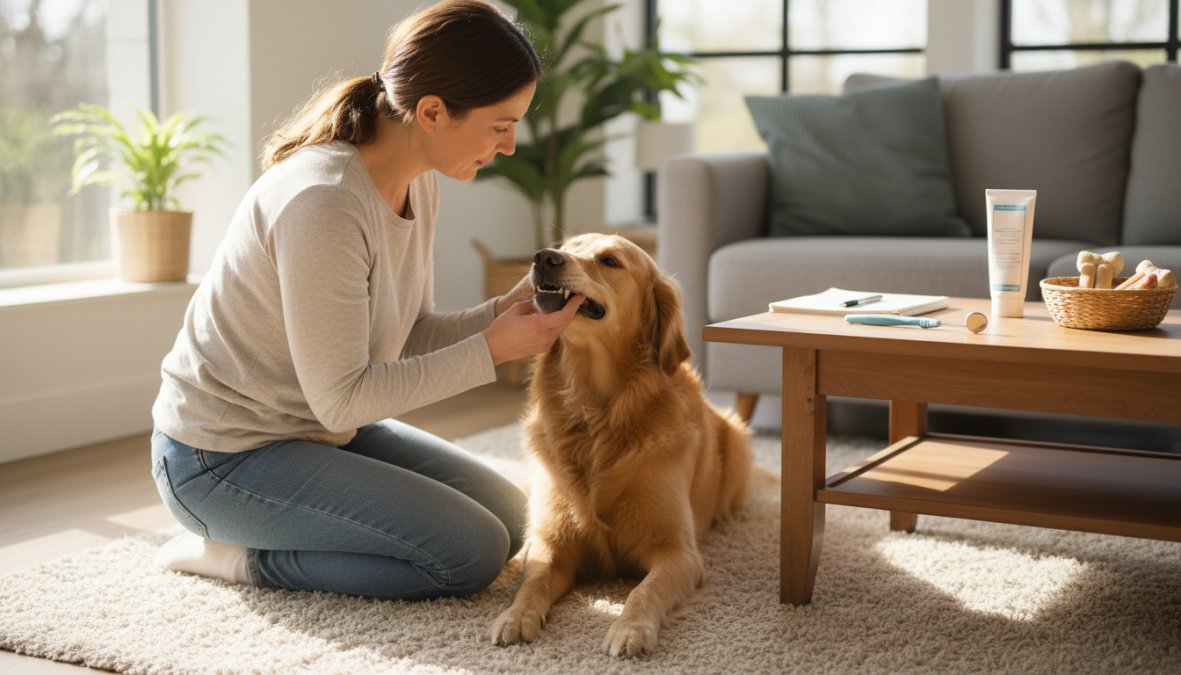
A pet owner kneeling on a hardwood living room floor, gently lifting the upper lip of a calm golden retriever to inspect its teeth, with warm natural daylight coming through a large window behind them
What a Healthy Pet Mouth Looks Like
A healthy pet mouth has pale pink gums with no swelling at the tooth margin, white to slightly off-white teeth with no visible calculus deposits, no detectable odor beyond a mild, neutral smell, and firm gum tissue that doesn’t bleed when touched gently.
Use this quick home screening checklist monthly:
-
Gums are pale pink, not red, white, or purple
-
No visible yellow, brown, or gray deposits on teeth
-
No swelling along the jawline or below the eye
-
Pet allows gentle lip-lifting without flinching or snapping
-
No persistent bad breath detectable at arm’s length
-
Pet is eating normally without dropping food or chewing on one side
-
No excessive drooling outside of mealtime or play
If two or more boxes are unchecked, schedule a veterinary oral exam.
Breed-Specific Dental Risks to Watch For
Breed matters significantly in dental disease risk, and this is an angle most general guides skip. Brachycephalic breeds, including Bulldogs, Pugs, Shih Tzus, Persian cats, and Boston Terriers, have teeth crowded into a shortened jaw. That crowding creates abnormal contact between teeth and traps plaque in areas that are nearly impossible to clean. These breeds develop periodontal disease faster and often need more frequent professional cleanings.
Small dog breeds, including Chihuahuas, Yorkshire Terriers, Dachshunds, and Toy Poodles, are disproportionately prone to dental disease because their small jaws create similar crowding issues. Malocclusion, the misalignment of teeth, is also more common in these breeds and creates additional wear patterns and food traps.
Greyhounds and Whippets have a genetic predisposition to periodontal disease that appears independent of diet or hygiene. Rabbits, which CorePet also treats, have continuously growing teeth that require monitoring for malocclusion, overgrowth, and spurs that can cause painful oral ulcers.
Key TakeawaySmall and brachycephalic breeds should be scheduled for professional dental evaluations at least once per year, starting at age one, rather than waiting for visible signs of disease. Early intervention in these breeds prevents the accelerated bone loss that crowded dentition promotes.
The Link Between Oral Health and Systemic Disease
Oral bacteria and systemic disease are directly connected, and the mechanism is well-documented in veterinary medicine. When periodontal pockets deepen, the gum tissue becomes ulcerated, creating a direct pathway for oral bacteria to enter the bloodstream. This bacteremia, bacteria circulating in the blood, triggers inflammatory responses in distant organs.
The kidneys and heart are the organs most frequently implicated. As documented in veterinary dental research published by the American Veterinary Dental College, the connection between advanced periodontal disease and kidney and heart health complications in dogs is an established area of clinical concern. The liver is also affected, as it filters blood and bears the burden of clearing bacterial toxins.
This systemic connection reframes how to think about dental cleanings. A professional cleaning under anesthesia, with dental radiographs to assess bone levels, isn’t a cosmetic procedure. It’s disease management with documented implications for organ health and lifespan.
Cats with chronic kidney disease, which is extremely common in older cats, are particularly vulnerable to the compounding effects of oral infection. Managing dental disease in these patients is part of managing their overall systemic health.
Preventative Pet Dental Care Tips That Actually Work
The most effective preventative pet dental care tips share one characteristic: they involve mechanical plaque removal, not just freshening breath.
Daily brushing with a veterinarian-recommended enzymatic toothpaste, such as Virbac C.E.T. Enzymatic Toothpaste, is the gold standard. The dual-enzyme system in these formulations actively inhibits plaque formation between brushing sessions. Never use human toothpaste, which contains xylitol and fluoride compounds that are toxic to pets.
For pets that resist brushing, alternatives include:
-
Dental water additives like Oxyfresh Premium Pet Dental Water Additive, which uses stabilized chlorine dioxide to neutralize the volatile sulfur compounds that cause bad breath. It’s odorless and tasteless, making it practical for resistant pets.
-
VOHC-approved dental chews like OraVet Dental Hygiene Chews, which combine mechanical scrubbing with delmopinol to create a barrier against plaque adhesion.
-
Food-based supplements like ProDen PlaqueOff Powder, a natural kelp-based supplement that works systemically through saliva to affect plaque composition. It takes several weeks to show results but requires no cooperation from the pet.
-
Dental wipes like Skout’s Honor Dental Wipes or Vet’s Best Dental Care Finger Wipes for targeted cleaning along the gumline without a brush.
The Veterinary Oral Health Council’s accepted product list is the most reliable resource for evaluating whether a dental product has clinical evidence behind its claims. Products carrying the VOHC seal have met defined standards for plaque or tartar reduction in controlled trials.
Home care slows disease progression but does not replace professional cleaning. It’s a maintenance strategy, not a cure.
Understanding the Cost of Pet Dental Care and Insurance
Pet dental care costs vary significantly based on the procedure, the pet’s size, and the extent of disease. A routine professional cleaning under anesthesia, including pre-anesthetic bloodwork, the cleaning itself, dental scaling, and polishing, costs more than a wellness visit but far less than treating the systemic complications of advanced periodontal disease.
Tooth extraction costs more than prevention. Treating a tooth root abscess, managing kidney complications linked to chronic oral infection, or extracting multiple teeth in a Stage 4 periodontitis case represents a substantially higher expense than annual cleanings.
Pet insurance policies vary in their dental coverage. Many standard policies exclude dental disease as a pre-existing or preventable condition. Wellness add-ons that cover routine dental cleanings are available from several major providers and are worth evaluating before disease is present. According to the North American Pet Health Insurance Association’s annual industry report, pet insurance enrollment has grown substantially, with dental coverage increasingly requested by policyholders.
CorePet’s pricing for dental procedures is listed transparently on the CorePet pricing page, which reflects the clinic’s commitment to making essential dental care accessible at reasonable costs. Knowing the cost upfront removes one of the most common barriers owners cite when delaying care.
When to Schedule a Veterinary Dental Appointment in Manchester, NH
The straightforward answer: don’t wait for an emergency. Any pet showing one or more of the 6 signs your pet needs urgent dental care should be seen promptly, not at the next annual wellness visit.
For Manchester, NH pet owners looking for dental care near me, CorePet operates as a locally owned surgery center focused exclusively in spay, neuter, and dental procedures. Corepet Surgical Center is focused on dental surgery, uses more advanced equipment, performs more procedures, and develops deeper clinical expertise than a general practice that offers dentistry as one of many services.
Pets in Manchester and across New Hampshire benefit from having access to a dedicated dental facility that uses modern surgical techniques and modern equipment, performs dental radiographs to assess bone loss that isn’t visible on the surface, and provides individualized care at reasonable costs.
Schedule a veterinary dental appointment in Manchester if your pet:
-
Has not had a professional dental cleaning in the past 12 months
-
Is showing any of the signs covered in this guide
-
Belongs to a high-risk breed (small dog, brachycephalic, or Greyhound)
-
Is over age three and has never had a dental oral exam under anesthesia
The AVMA guidelines recommend annual dental evaluations for most adult pets, with more frequent visits for high-risk breeds and older animals. Following that guidance in Manchester, NH means not waiting until you can smell the problem from across the room.
Dental disease is progressive, painful, and directly connected to your pet’s organ health. CorePet has a vast amount of experience in dental procedures for dogs & cats in the Manchester, New Hampshire, using modern surgical techniques and equipment to deliver professional cleanings, dental radiographs, and extractions at transparent, reasonable costs. If your pet is showing any of the signs covered here, book an appointment with CorePet and get a clear picture of what’s actually happening beneath the gumline before the disease advances further.
Frequently Asked Questions
What are the signs of dental pain in pets?
Pets rarely vocalize dental pain, which makes behavioral changes key indicators. Watch for difficulty chewing, dropping food, excessive drooling, pawing at the mouth, reluctance to be touched near the face, and increased irritability. Halitosis, facial swelling, and lethargy can also signal that your pet is experiencing oral discomfort. These signs often point to periodontal disease, a tooth abscess, or advanced gingivitis requiring prompt veterinary attention.
How can I tell if my dog or cat has a tooth infection?
A tooth infection often presents as visible facial swelling below one eye or along the jaw, persistent bad breath, drooling, and anorexia or reluctance to eat. Your pet may also paw at their face or show sudden behavioral changes. A veterinary oral exam and dental radiographs are needed to confirm a tooth root abscess. Left untreated, a tooth infection can spread into surrounding tissue and potentially enter the bloodstream, making early diagnosis critical.
Is pet dental disease considered an emergency?
Not all dental disease is an immediate emergency, but certain signs warrant urgent care. Facial swelling, signs of dysphagia, complete anorexia, or a visibly fractured tooth should be treated as urgent. Moderate periodontitis causing pain and behavioral changes also needs prompt attention, even if it isn't life-threatening. The 6 signs your pet needs urgent dental care — including halitosis, gum inflammation, and lethargy — are your cue to book a veterinary appointment without delay.
What preventative pet dental care tips actually help at home?
Daily tooth brushing with a veterinarian-approved enzymatic toothpaste is the gold standard for preventative pet dental care. For pets that resist brushing, dental water additives, VOHC-approved dental chews, and finger wipes offer practical alternatives. Food-based supplements like seaweed powders can support long-term oral hygiene. Combine these at-home strategies with annual or biannual professional cleanings, including dental scaling and polishing, to keep plaque and tartar from progressing to periodontal disease.
What do the stages of periodontal disease in pets look like?
Periodontal disease progresses in four stages. Stage 1 is gingivitis — reversible gum inflammation with no bone loss. Stage 2 involves early periodontitis with up to 25% attachment loss. Stage 3 shows moderate bone and tissue destruction. Stage 4 is advanced periodontitis with severe bone loss, tooth mobility, and risk of systemic infection affecting kidney and heart health. Understanding these stages helps pet owners recognize when home care is sufficient versus when professional dental intervention is essential.