Table of Contents
- Spay vs Neuter Recovery Time Differences: A Side-by-Side Overview
- Neutering Recovery Timeline: Day-by-Day Breakdown for Dogs and Cats
- Why Spay Recovery Takes Longer: Key Factors That Affect Healing
- Post-Spay Care Tips to Support a Smooth Recovery
- Signs of Complications After Pet Surgery You Should Never Ignore
- What Is Included in the Surgery Fee and Hidden Costs to Know
- Spay vs Neuter Recovery Time Differences: Comparison Table and Cost Breakdown
- Conclusion
Last Updated: May 25, 2026
Understanding spay vs neuter recovery time differences is one of the most common questions pet owners face after scheduling their companion animal’s surgery, and getting it wrong leads to real complications. This guide from CorePet breaks down exactly what to expect from each procedure, why the timelines differ, and how to keep your pet safe through every stage of healing. The short answer: neuters typically require 7-10 days of restricted activity, while spays often need 10-14 days or longer, depending on species, size, and surgical method. Below, we’ll show you exactly how to manage each phase, what warning signs demand immediate veterinary attention, and which hidden costs to ask about before you book.
Here’s what most guides get wrong: they treat recovery as a single event rather than a phased process. The real risk isn’t the surgery itself. It’s the week after, when pets feel better before they’ve actually healed.
Spay vs Neuter Recovery Time Differences: A Side-by-Side Overview
Recovery timelines between spays and neuters differ primarily because of the invasiveness of each procedure. A spay involves entering the abdominal cavity to remove reproductive organs, while a neuter is typically a much simpler external procedure. That anatomical difference drives everything from pain medication duration to activity restrictions.
What Is a Spay (Ovariohysterectomy or Ovariectomy)?
A spay is the surgical sterilization of a female companion animal through removal of the reproductive organs. An ovariohysterectomy removes both the ovaries and the uterus, while an ovariectomy removes only the ovaries. Both eliminate heat cycles and the risk of uterine infections (pyometra), which are among the most serious health threats female dogs and cats face.
Because the surgeon must enter the abdominal cavity, make internal ligatures, and close multiple tissue layers, the procedure carries more surgical complexity than a standard neuter. This is the core reason spay recovery takes longer.
What Is a Neuter and How Does It Differ?
A neuter is the surgical removal of the testes in male animals, eliminating the primary source of testosterone and preventing reproduction. In most standard cases, the procedure is performed through a small scrotal or pre-scrotal incision, with the testes removed and the incision closed in a single layer.
The exception is a cryptorchid neuter, where one or both testes have not descended into the scrotum. In these cases, the surgeon must locate the retained testis inside the inguinal canal or abdominal cavity, making the procedure substantially more complex and extending recovery time closer to that of a spay.
According to ASPCA’s pet care and sterilization resources, sterilization of companion animals remains one of the most impactful health decisions an owner can make, reducing risks of reproductive cancers and contributing to pet population control.
Neutering Recovery Timeline: Day-by-Day Breakdown for Dogs and Cats
The neutering recovery timeline is predictable when managed correctly. Most male dogs and cats follow a consistent arc: peak discomfort in the first 48 hours, significant improvement by day five, and full clearance around day ten. The biggest mistake owners make is interpreting "seems fine" as "is healed."
Days 1-3: Immediate Post-Operative Period
The first 72 hours are the most critical. Your pet will return home still processing residual anesthesia effects. Expect drowsiness, reduced appetite, and mild disorientation. Pain medication prescribed by your veterinarian should be administered on schedule, not just when the animal appears distressed.
Key priorities during this window:
- Confine your pet to a small, calm space with limited jump-up or jump-down opportunities
- Check the incision site morning and evening for swelling, discharge, or separation
- Prevent licking using an E-collar or recovery suit (more on those below)
- Offer water freely; withhold food for the first few hours if your vet advises it
Days 4-10: Incision Monitoring and Activity Restriction
This is the phase where most complications occur. The incision begins to itch as it heals, pets feel considerably better, and owners relax restrictions too early. Resist that instinct.
Internal sutures are still consolidating during this window. Vigorous activity, running, or rough play can cause suture breakdown before the tissue has knit together. Keep walks short and leashed. No stairs if avoidable. No off-leash time.
Monitor the incision site for these specific changes: redness spreading beyond the immediate wound edge, any discharge that is not clear or slightly pink, firm swelling that increases rather than decreases, or any opening of the wound edges.
Days 10-14 and Beyond: Return to Normal Activity
Most male dogs and cats receive clearance from their veterinarian around day ten, assuming the incision has healed cleanly and no complications have developed. External sutures (if used) are typically removed at this visit.
Return to full activity should still be gradual. A dog that has been restricted for ten days does not have the same muscle conditioning it had before surgery. Reintroduce exercise progressively over several days.
Schedule your post-operative recheck before you leave the clinic on surgery day. Owners who book the follow-up appointment in advance are significantly less likely to skip it, and that recheck is where early complications get caught.
Why Spay Recovery Takes Longer: Key Factors That Affect Healing
The spay vs neuter recovery time difference comes down to one fundamental fact: abdominal surgery heals more slowly than external surgery. But that’s only the starting point. Several variables can extend or compress a spay’s recovery window considerably.
Species, Size, Age, and Breed Considerations
Cats generally recover faster than dogs from both procedures, partly because of their smaller body mass and partly because feline surgeries tend to involve smaller incisions. A young, healthy cat spay may reach full recovery in ten days. A large-breed dog spay may require closer to two weeks or more.
Age matters significantly. Younger animals heal faster, which is one reason veterinarians often recommend sterilization before the first heat cycle. Older animals produce collagen more slowly, and their immune response to surgical stress is less efficient.
Breed plays a role too. Short-muzzled breeds (brachycephalic dogs like Bulldogs, Pugs, and French Bulldogs) carry higher anesthetic risk and often require more careful post-operative monitoring because of their compromised airways. These pets may need extended observation before discharge and closer follow-up during recovery.
In-Heat or Pregnant Status and Cryptorchid Neuters
Performing a spay on a female who is currently in heat or pregnant significantly increases surgical complexity. Blood vessels supplying the reproductive organs are engorged, making the procedure longer and increasing the risk of intraoperative bleeding. Recovery for in-heat spays typically extends by several days, and some veterinary hospitals prefer to wait until the heat cycle concludes before scheduling surgery.
Cryptorchid neuters, as noted above, require abdominal exploration when the retained testis cannot be located externally. This converts what would have been a simple procedure into something closer to an abdominal surgery, with a corresponding increase in recovery time and post-operative care requirements.
Post-Spay Care Tips to Support a Smooth Recovery
The most effective post-spay care is not complicated, but it requires understanding why each restriction exists, because owners who understand the mechanism behind a rule follow it far more consistently than owners who are simply told what to do. This section explains the reasoning behind each care step, not just the step itself.

Why Spay Recovery Demands More Active Management Than a Neuter
A spay involves three distinct tissue layers that must heal independently and in sequence: the body wall muscle, the subcutaneous fat layer, and the skin. Internal sutures placed in the muscle layer are doing the structural work. The skin closure you can see is the least important layer mechanically, it is the internal sutures that, if disrupted, cause the serious complications.
This is why a dog that appears completely normal on day four is not actually healed. The internal muscle layer typically requires the full 10-14 days to reach the tensile strength needed to withstand normal activity. The skin can look closed and clean while the deeper layers are still consolidating. Owners who interpret a good-looking incision as a healed incision are the ones who end up back at the emergency clinic.
Phase 1 (Days 1-3): Managing Anesthesia Aftereffects and Establishing the Recovery Space
The first 72 hours are dominated by two overlapping processes: the body clearing residual anesthesia and the initial inflammatory response to surgery beginning. Both are normal. Both require specific management.
Anesthesia clearance takes longer than most owners expect. Residual effects, mild disorientation, unsteady gait, reduced appetite, and temperature dysregulation, can persist for 18-24 hours in some animals, particularly older pets or those with slower hepatic metabolism. Keep your pet warm (but not overheated), confined to a single room, and away from stairs, furniture edges, and other pets during this window.
The inflammatory response is what causes the swelling and warmth you’ll see around the incision in the first 48 hours. This is the body’s intended healing mechanism, not a sign of infection. Mild swelling that is warm to the touch and does not increase after day two is expected. Swelling that continues to grow after day two, or that is accompanied by heat spreading beyond the immediate wound margin, is the signal to call your veterinarian.
Setting up the recovery space correctly matters more than most guides acknowledge. Specific requirements:
- Floor-level sleeping area, no jumping up or down to reach the bed
- Water accessible without stretching or straining
- Food bowl at floor height (raised feeders require core muscle engagement)
- Separation from other household pets, including well-meaning ones, even gentle sniffing at the incision site introduces bacteria
- A non-slip surface underfoot, post-anesthesia unsteadiness combined with a slippery floor is a fall risk
Phase 2 (Days 4-10): The High-Risk Window Most Owners Underestimate
This is the phase where the majority of post-spay complications occur, and the reason is straightforward: the pet feels dramatically better, the owner relaxes, and activity resumes before the internal sutures have finished consolidating.
The itch of healing tissue is a real physiological phenomenon. As new collagen fibers form and nerve endings regenerate, the incision site becomes itchy, which drives licking behavior even in pets that showed no interest in the wound on day one. This is the primary reason E-collar compliance must be maintained through the full restriction period, not just the first few days.
Activity restriction during this phase means:
- Leashed bathroom walks only, no off-leash time, no yard access without a leash
- Walks limited to 5-10 minutes, on flat ground
- No stairs if avoidable; if unavoidable, support the hindquarters going up and down
- No interaction with other pets that could escalate to play
- No car trips unless medically necessary (vibration and bracing engage core muscles)
- No bathing or water exposure to the incision site
What to look for at the incision site during twice-daily checks:
| What you see | What it means | What to do |
|---|---|---|
| Mild swelling, slight bruising, pink edges | Normal days 1-3 | Continue monitoring |
| Gradual flattening, edges approximating | Normal days 4-7 | Continue monitoring |
| Redness spreading beyond wound margin | Possible early infection | Call vet same day |
| Yellow or green discharge | Infection likely | Call vet same day |
| Clear or light pink fluid, small amount | Normal days 1-2 | Monitor; call if persists |
| Any gap between wound edges | Dehiscence, serious | Emergency vet visit |
| Firm, growing lump under incision | Possible seroma or hernia | Call vet within 24 hours |
| Foul odor from incision | Infection | Call vet same day |
Incision Care, Pain Medication, and Antibiotics
Check the incision twice daily, morning and evening, at the same time you administer medications. Building the check into a medication routine increases compliance and means you are never more than 12 hours from detecting a change.
Pain medication is not optional, and undertreated pain is counterproductive. A pet in unmanaged pain moves more, not less, because discomfort creates restlessness. NSAIDs prescribed for post-spay pain (commonly meloxicam in dogs, with species-appropriate alternatives for cats) also reduce the inflammatory response at the incision site, supporting faster healing. Administer on schedule, with food unless your veterinarian specifies otherwise, and never substitute human NSAIDs, ibuprofen and acetaminophen are toxic to dogs and cats.
If antibiotics are prescribed, complete the full course. Stopping antibiotics when the pet appears recovered, rather than when the course is finished, is one of the most common owner errors in post-surgical care. Incomplete antibiotic courses select for resistant bacteria and can allow a subclinical infection to rebound after apparent recovery.
Do not apply topical products to the incision unless specifically directed by your veterinarian. Hydrogen peroxide, alcohol, and many over-the-counter antiseptics are cytotoxic to healing tissue, they damage the new cells forming at the wound edge. A clean, dry incision heals faster than one that has been treated with topical products.
The NHV Post-Op Kit offers a natural supplement approach to post-surgical support, including Milk Thistle for liver recovery after anesthesia, Yucca for inflammation management, and Probiotics to restore gut flora disrupted by antibiotics. At $93.95 for the bundle, it addresses multiple recovery concerns simultaneously for owners who prefer a holistic approach, but discuss any supplements with your veterinarian before administering, as some botanicals interact with prescribed medications.
E-Collar Alternatives and Recovery Suits
The standard rigid plastic Elizabethan collar is the most reliably effective barrier between your pet and the incision site, but it is also the option pets find most distressing, and a stressed pet is a more active, harder-to-manage patient. Two alternatives worth knowing:
The All Four Paws Comfy Cone ($17.99) is constructed from soft, foam-backed padded nylon that allows pets to sleep, eat, and navigate doorways more comfortably than a rigid cone. It can be folded back when your pet is under direct supervision. The honest limitation: highly determined lickers can sometimes compress the soft material enough to reach the incision, so it works best for pets that are not obsessive about the wound site.
The VetMedWear Recovery Suit ($26.49) covers the incision with a full-body garment made from 94% organic cotton and 6% Lycra, with specific openings for bathroom breaks and a full-length zipper for removal. It eliminates the spatial disorientation many pets experience with cone collars and allows normal sleep positions. The trade-off: fabric-based protection can be defeated by a pet that chews aggressively at the garment, and the suit must be removed and inspected at each incision check to ensure the fabric is not trapping moisture against the wound.
For pets that tolerate neither option, a combination approach, recovery suit during supervised daytime hours, rigid cone during unsupervised periods and overnight, provides reliable protection while reducing total cone time.
Never remove the E-collar or recovery suit unsupervised during the first ten days, even briefly. Most incision disruptions happen in under a minute when the owner steps out of the room. A single licking episode can introduce bacteria, pull sutures, or cause enough tissue trauma to require a return surgical visit.
Phase 3 (Days 10-14): Clearance, Gradual Return, and What ‘Healed’ Actually Means
Veterinary clearance at the day-10 to day-14 recheck does not mean the incision is at full strength. Collagen remodeling, the process by which new scar tissue reaches its final tensile strength, continues for weeks to months after the visible wound has closed. What clearance means is that the risk of acute suture failure from normal activity has passed.
Return to full activity should be graduated over several days following clearance:
- Days 10-12 post-clearance: normal leashed walks, no running or jumping
- Days 12-14 post-clearance: short off-leash sessions in a controlled environment
- Full activity: reintroduce gradually, watching for any signs of discomfort at the incision site
Large and giant breed dogs, older animals, and any pet that experienced a complication during recovery should follow a more conservative return-to-activity timeline. When in doubt, ask your veterinarian for a specific protocol rather than defaulting to the standard timeline.
Schedule your post-operative recheck before you leave the clinic on surgery day. Owners who book the follow-up appointment in advance are significantly less likely to skip it, and that recheck is where early complications get caught before they become emergencies.
Signs of Complications After Pet Surgery You Should Never Ignore
Recognizing signs of complications after pet surgery early is the difference between a simple phone call to your vet and an emergency visit. Most complications are manageable when caught within the first 24 hours. They become serious when owners wait.
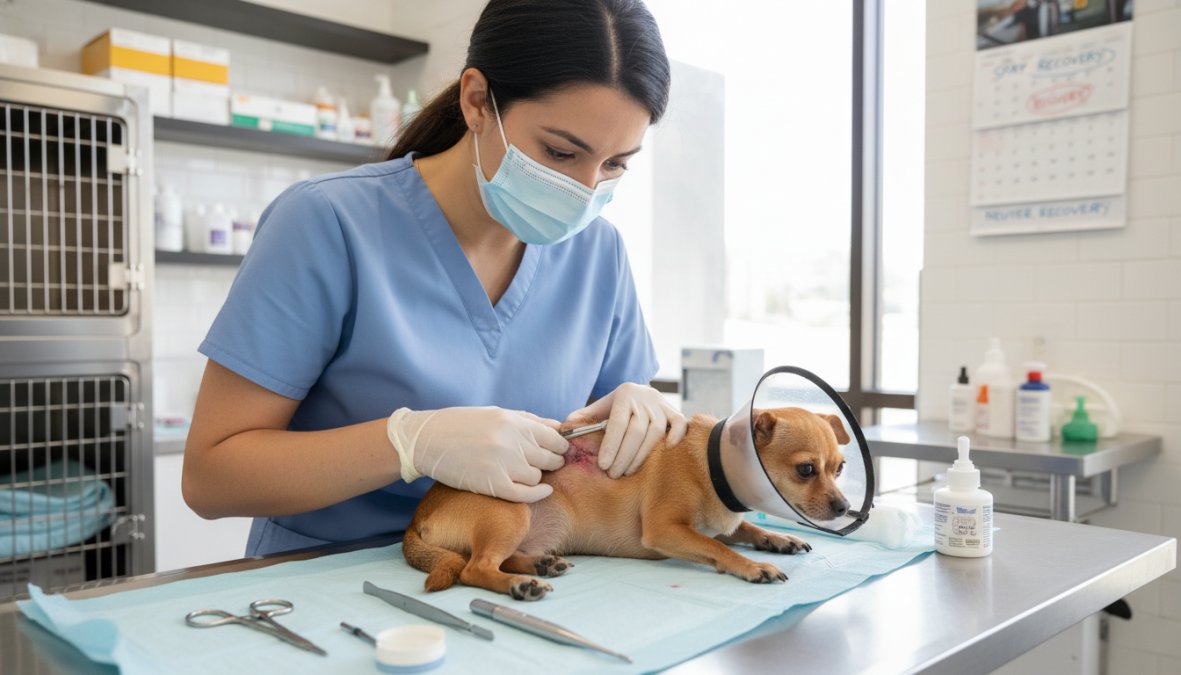
Contact your veterinarian immediately if you observe any of the following:
- Incision opening: Any gap in the wound edges, regardless of size
- Excessive swelling: Swelling that increases after day two rather than decreasing
- Discharge changes: Yellow, green, or foul-smelling discharge (clear or light pink is normal in the first 48 hours)
- Persistent vomiting: One episode post-anesthesia is common; repeated vomiting is not
- Pale or white gums: A sign of internal bleeding that requires emergency care
- Extreme lethargy beyond day two: Some drowsiness is expected; inability to stand or respond is not
- Straining to urinate: Can indicate a urinary complication, particularly in cats
As documented in AVMA’s guidelines on post-operative pet care, early identification of surgical complications dramatically improves outcomes. The window for effective intervention is narrow.
What Is Included in the Surgery Fee and Hidden Costs to Know
The out-the-door cost of a spay or neuter often differs substantially from the quoted surgery fee. Understanding what’s included, and what isn’t, prevents unpleasant surprises on pickup day.
Standard Inclusions: Anesthesia, IV Fluids, and Pre-Anesthetic Chemistries
A well-structured surgery fee at a quality clinic should include anesthesia, IV fluids during the procedure, and the surgeon’s time. Many clinics also include a basic pre-anesthetic exam. However, pre-anesthetic chemistries (bloodwork to check organ function before anesthesia is administered) are frequently listed as a separate add-on, particularly for older animals.
IV fluids during surgery are not a luxury. They maintain blood pressure during anesthesia and support kidney function. If a quoted price seems unusually low, ask specifically whether IV fluids and anesthetic monitoring are included.
Pain medication to go home with is another common exclusion. Some clinics send pets home with a single dose; others include a multi-day supply. Clarify this before surgery day.
Hidden Costs Checklist: What to Ask Before You Book
Use this checklist when comparing clinics or speaking with your veterinary hospital:
- Is pre-anesthetic bloodwork included or optional?
- Are IV fluids and continuous anesthetic monitoring included?
- What pain medication is sent home, and is it included in the fee?
- Are antibiotics included if prescribed?
- Is the post-operative recheck visit included or billed separately?
- Is an E-collar included, or will I need to purchase one?
- Are there additional fees for pets in heat, pregnant, or cryptorchid?
- Does the price include microchipping, or is that separate?
- Are vaccination services available at the time of surgery, and at what cost?
- Is there a sterilization certificate provided for pet license requirements?
Low-cost clinic and voucher program options exist in most regions through nonprofits and local animal welfare organizations. Income-based financial assistance tied to Area Median Income thresholds is available in many municipalities. These programs often provide wellness exams alongside sterilization, making them worth investigating before assuming surgery is out of budget.
The out-the-door cost of a spay or neuter is almost always higher than the base surgery fee. Ask for a complete itemized estimate before booking, not just the headline price.
Spay vs Neuter Recovery Time Differences: Comparison Table and Cost Breakdown
The table below is the reference most pet owners actually need: a single, unified view of how spay and neuter procedures compare across recovery time, procedure characteristics, and realistic cost ranges for both dogs and cats. Most resources separate this information by species or by cost, forcing owners to piece together an incomplete picture. This table combines both.
Unified Spay vs. Neuter Comparison Table: Recovery and Cost
| Factor | Cat Spay | Cat Neuter | Dog Spay (small/medium) | Dog Spay (large/giant) | Dog Neuter (standard) | Cryptorchid Neuter |
|---|---|---|---|---|---|---|
| Procedure type | Abdominal | External/scrotal | Abdominal | Abdominal | External/scrotal | Abdominal exploration |
| Average recovery time | 10-12 days | 5-7 days | 10-14 days | 14+ days | 7-10 days | 10-14 days |
| Activity restriction period | 10-12 days | 5-7 days | 10-14 days | 14+ days | 7-10 days | 10-14 days |
| Incision location | Flank or midline abdomen | Scrotal | Midline abdomen | Midline abdomen | Scrotal/pre-scrotal | Abdomen or inguinal |
| Anesthesia duration | Shorter | Shortest | Moderate | Longer | Short | Moderate to longer |
| Complexity increase if in heat | Yes | N/A | Yes, significantly | Yes, significantly | N/A | N/A |
| Typical base cost range (private clinic) | $200-$500 | $100-$300 | $300-$600 | $400-$800+ | $150-$400 | $300-$600+ |
| Typical low-cost clinic range | $50-$150 | $30-$100 | $75-$200 | $100-$300 | $50-$150 | $100-$250 |
| IV fluids recommended | Yes | Yes | Yes | Yes | Yes | Yes |
| E-collar required | Yes | Yes | Yes | Yes | Yes | Yes |
| Pre-anesthetic chemistries advised | Older cats / high-risk | Older cats | Yes | Yes | Older dogs | Yes |
Important note on cost ranges: These ranges reflect commonly reported figures from veterinary cost surveys and nonprofit clinic disclosures. Your actual out-of-pocket cost will depend on your region, your clinic type, and which add-ons are included. Always request an itemized estimate.
Geographic Cost Variance: Why Location Changes Everything
One factor almost no recovery guide addresses is how dramatically geography affects what you pay for the same procedure, and therefore how much financial stress surrounds the recovery period itself.
As a general pattern across the United States:
- Urban markets (major metro areas in California, New York, Massachusetts, and the Pacific Northwest) tend to carry the highest private-clinic prices, driven by real estate overhead, higher staff wages, and elevated cost of living. A dog spay in San Francisco or New York City at a private practice can reach the upper end of published ranges or exceed them.
- Rural and suburban markets in the South, Midwest, and Mountain West tend to run 20-40% lower for equivalent procedures at comparable-quality facilities.
- Low-cost clinic networks, operated by nonprofits, humane societies, and municipal animal services, exist in most regions and can bring costs down to a fraction of private-practice rates regardless of geography. Organizations like the ASPCA, the Humane Society of the United States, and regional spay/neuter coalitions maintain searchable directories of these programs.
- Income-based assistance programs tied to Area Median Income (AMI) thresholds are available in many municipalities. Eligibility criteria vary, but many programs serve households at 80% AMI or below. Contact your local animal services department or humane society to ask specifically about voucher availability.
The practical implication for recovery planning: owners who use low-cost clinics sometimes encounter shorter post-operative consultation windows or less included aftercare. This is not a quality indictment, many low-cost clinics perform high volumes of these procedures with excellent outcomes, but it does mean you may need to be more proactive about scheduling your own follow-up with a general practice veterinarian if a recheck visit is not included.
Does Pet Insurance Cover Spay or Neuter Surgery?
This is one of the most common questions owners ask, and the answer is almost universally misunderstood.
Standard accident-and-illness pet insurance policies do not cover elective spay or neuter surgery. These procedures are classified as routine preventive care, which falls outside the scope of most base insurance plans. Submitting a spay or neuter claim to a standard policy will typically result in a denial.
The exception is pet wellness plans, which are either add-ons to existing insurance policies or standalone annual plans offered by insurers and some veterinary chains. Wellness plans are designed specifically to cover routine and preventive care, and many explicitly include spay/neuter reimbursement up to a stated annual limit. Common wellness plan structures reimburse a flat amount (often in the $75-$200 range) toward sterilization, which offsets but rarely covers the full cost.
Key questions to ask your insurer or wellness plan provider before surgery:
- Is spay/neuter covered under my current plan, or only under a wellness add-on?
- Is there a waiting period before sterilization coverage activates?
- Is reimbursement a flat amount or a percentage of the invoice?
- Does coverage apply to the base surgery fee only, or does it extend to pre-anesthetic bloodwork and pain medication?
If you are purchasing pet insurance for a new pet, enrolling before scheduling sterilization and adding a wellness rider at enrollment is the most cost-effective approach. Attempting to add wellness coverage after surgery has been scheduled may trigger a waiting period that excludes the upcoming procedure.
The Hidden Costs That Inflate Your Final Bill
The base surgery fee is rarely the number you pay at checkout. The following checklist captures the most common add-on costs that surprise owners on pickup day. Use it when comparing clinics or requesting an estimate.
Before surgery:
- Pre-anesthetic bloodwork (organ function panel before anesthesia), frequently an add-on, especially for pets over 5 years
- Pre-surgical exam fee, sometimes billed separately from the procedure
- Required vaccinations if records are not current, some clinics require proof of rabies and DHPP/FVRCP before admitting a patient
Day of surgery:
- IV catheter placement and IV fluids during procedure, should be standard but is sometimes listed separately
- Continuous anesthetic monitoring (dedicated technician or monitoring equipment), ask specifically
- Microchipping, often offered at time of surgery at a discounted rate; confirm whether it is included or optional
- Intradermal (dissolving) sutures vs. external sutures requiring removal, external sutures mean a return visit
Going home:
- Take-home pain medication (multi-day supply vs. single dose)
- Antibiotics if prescribed
- E-collar or recovery suit, many clinics charge separately; budget $15-$30 if not included
- Written discharge instructions (should be free, but confirm)
After surgery:
- Post-operative recheck visit, may or may not be included in the surgery fee
- Suture removal appointment if external sutures were used
- Any complication-related visits, not predictable, but worth knowing your clinic’s policy on post-surgical complication fees
The out-the-door cost of a spay or neuter is almost always higher than the base surgery fee. Ask for a complete itemized estimate before booking, not just the headline price, and run through the hidden costs checklist above to avoid surprises on pickup day.
The most important insight the full table captures: the difference in recovery time between a spay and a standard neuter is consistent but not dramatic. Plan for at least two full weeks of modified household routines regardless of which procedure your pet is having. That buffer protects against the most common post-operative mistake, which is resuming normal activity three to four days too early, before internal sutures have consolidated.
According to Humane Society’s resources on spay and neuter benefits, sterilized pets live longer on average than intact animals, partly because of reduced cancer risk and partly because of reduced roaming behavior that leads to injury. The recovery investment is worth making correctly, and understanding the full cost picture before surgery day is part of making it correctly.
Frequently Asked Questions
Is neutering recovery faster than spaying?
Yes, in most cases neutering recovery is faster than spaying. A male dog or cat undergoing a standard neuter typically returns to normal activity within 5-7 days. Spaying involves a more invasive abdominal incision to remove the reproductive organs, which generally requires 10-14 days of restricted activity. The spay vs neuter recovery time difference is most significant in larger dogs, where deeper tissue healing takes longer.
How long does it take for a dog to recover from being spayed?
Most dogs recover from a spay procedure within 10 to 14 days. During this period, you should limit running, jumping, and rough play. The external incision typically closes within 10 days, but internal tissue healing continues beyond that. Larger breeds and dogs that were in-heat at the time of surgery may need a few extra days of post-operative care before resuming normal activity.
What are the signs of infection after spay or neuter surgery?
Key signs of complications after pet surgery include excessive redness, swelling, or discharge at the incision site, a foul odor from the wound, your pet persistently licking or chewing the area, lethargy lasting more than 48 hours post-surgery, loss of appetite, vomiting, or a fever. If you notice any of these signs, contact your veterinary clinic immediately. Early intervention can prevent minor issues from becoming serious surgical complications.
What post-spay care tips help pets heal faster?
The most effective post-spay care tips include keeping the incision clean and dry, preventing licking with an e-collar or recovery suit, administering prescribed pain medication and antibiotics on schedule, and strictly limiting physical activity for the full recovery window. Offer a quiet, comfortable resting space and monitor the incision daily. Avoid baths until the wound is fully closed, and attend any scheduled follow-up wellness exams your veterinarian recommends.
When can my pet resume normal activity after being fixed?
For neutered males, light activity is usually safe after 5-7 days, with full activity resuming around day 10. For spayed females, most veterinarians recommend restricting activity for 10-14 days. The neutering recovery timeline can vary based on your pet's age, size, species, and whether any complications arose. Always follow your veterinarian's specific discharge instructions rather than relying on general timelines alone.
Does CorePet include pain medication and anesthesia in their surgery fee?
CorePet is a surgery center specializing exclusively in spay, neuter, and dental procedures, using modern surgical techniques to keep care safe and costs reasonable. Their pricing page outlines what is included in the out-the-door cost for each procedure. It is always a good idea to ask your provider specifically about anesthesia, IV fluids, pre-anesthetic chemistries, and post-operative pain medication so you understand the full cost before booking your appointment.
This article was written using GrandRanker