Table of Contents
Last Updated: May 27, 2026
The cat neuter procedure is one of the most common surgical operations performed on companion animals, yet most pet owners walk into it with surprisingly little preparation. This guide from CorePet covers everything from what happens in the operating room to how to manage your cat’s recovery at home, day by day. Below, you’ll find the preparation checklist most clinics never hand you, a frank look at anesthesia risks, and a breakdown of what your surgery fee actually covers.
Most guides stop at “book the appointment.” This one doesn’t.
What the Cat Neuter Procedure Actually Involves
A cat neuter procedure, also called orchiectomy or castration, is a surgical sterilization operation in which a licensed veterinarian removes a male cat’s testicles and the associated reproductive organs under general anesthesia. The goal is permanent removal of the cat’s ability to reproduce, along with the hormonal changes that drive territorial behavior, marking behavior, and roaming.
The surgery itself is straightforward. Two small incisions are made in the scrotal area, the testicles are exteriorized and ligated, and the incisions are typically left to heal without sutures or closed with absorbable sutures depending on the technique used.
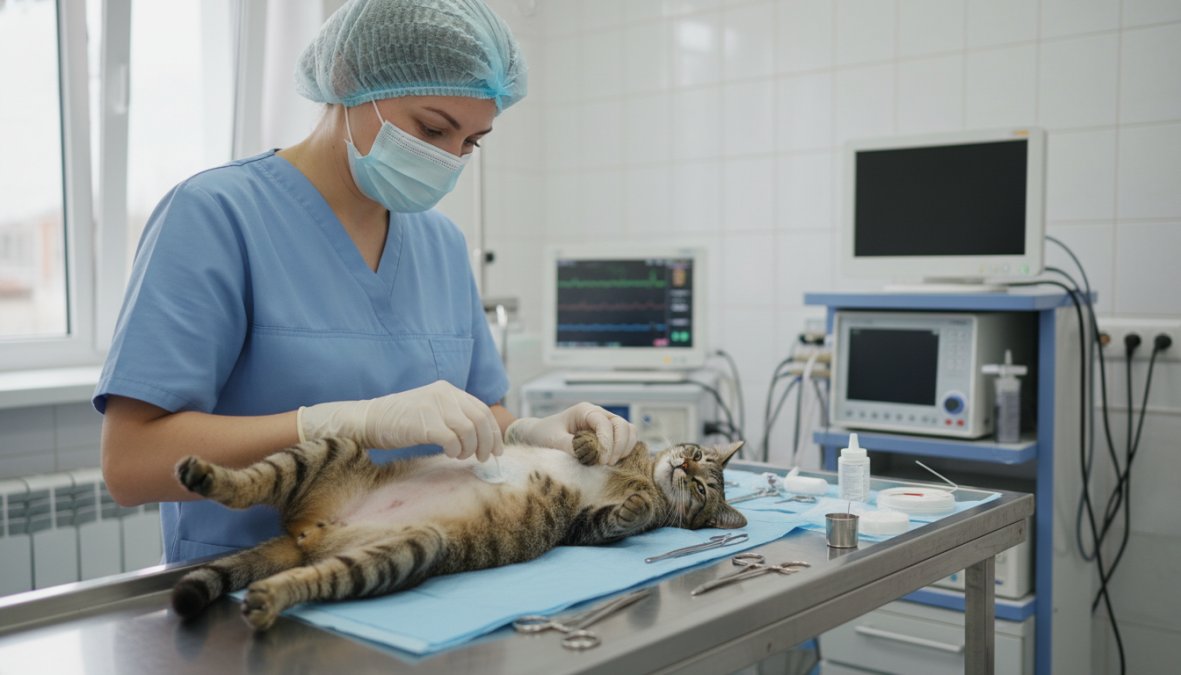
A licensed veterinarian in blue surgical scrubs preparing a calm, sedated cat on a stainless steel operating table in a clean, brightly lit veterinary operating room, with surgical instruments laid out on a sterile tray nearby
One thing many owners don’t realize: a standard neuter assumes both testicles have descended. If one or both testicles are retained inside the abdomen or inguinal canal, the cat is classified as cryptorchid, and the procedure becomes significantly more complex. A cryptorchid neuter requires abdominal surgery to locate and remove the retained testicle, which increases both surgical time and cost.
Watch OutNever assume a standard neuter fee covers a cryptorchid case. Always confirm testicular descent with your veterinarian before the surgery date. Proceeding without disclosure can result in incomplete sterilization and unexpected costs.
How Long the Surgery Takes
A standard cat neuter procedure takes roughly 5 to 20 minutes of actual surgical time for a healthy adult male cat with two descended testicles. The total time at the clinic, however, is much longer. Factor in pre-anesthetic examination, sedation, induction, monitoring during recovery, and observation before discharge. Most clinics schedule cats for a full-day drop-off, with pick-up in the afternoon.
Cryptorchid cases, older cats, or cats with pre-existing health conditions take longer and require more intensive monitoring.
Anesthesia Safety and Risks: What Pet Owners Should Know
Anesthesia is the part of the cat neuter procedure that concerns owners most, and that concern is reasonable. General anesthesia carries real, if low, risks for healthy young cats. The most common complications include respiratory depression, hypothermia during surgery, and adverse reactions to anesthetic agents.
Reputable clinics mitigate these risks through pre-anesthetic bloodwork, IV catheter placement for rapid drug delivery if needed, continuous monitoring of heart rate and oxygen saturation, and proper thermal support throughout the procedure. According to American Veterinary Medical Association guidelines on anesthetic safety, pre-surgical health screening significantly reduces the likelihood of anesthetic complications in otherwise healthy patients.
The risk profile for a young, healthy cat is low. The risk profile for a cat with undiagnosed heart disease or organ dysfunction is materially higher, which is why pre-operative screening matters.
Benefits of Neutering Your Cat Beyond Population Control
Pet overpopulation is the headline reason most people cite for neutering, and it’s a legitimate one. Shelters across the country take in millions of cats annually, and surgical sterilization is the most effective tool available for reducing that number over time. But focusing only on population control undersells the direct health and behavioral benefits to your individual cat, and ignores the questions most owners actually have: What will actually change? What won’t? And how quickly?
What Changes After Neutering, and Why
The behavioral effects of neutering are driven almost entirely by the removal of testosterone-producing tissue. Within days of surgery, circulating testosterone levels drop sharply. Most testosterone-driven behaviors follow the hormone down, though the timeline varies by how long the cat was intact before surgery.
Urine spraying and territorial marking Intact male cats spray urine as a hormonal signaling behavior, it communicates reproductive status to other cats. Because this behavior is directly testosterone-dependent, neutering before sexual maturity (typically before 5-6 months) eliminates it in the large majority of cats. Cats neutered after they’ve established the habit may show reduced spraying, but some will continue, because the behavior has been reinforced by learning, not just hormones. If spraying is the primary reason you’re neutering an older cat, discuss realistic expectations with your veterinarian before surgery.
Roaming and escape behavior Intact males are biologically driven to roam in search of mates, sometimes traveling significant distances. This roaming is the primary reason intact male cats face higher rates of vehicle trauma, predator encounters, and territorial fights with other cats. Neutering substantially reduces roaming motivation, though cats that have roamed extensively before surgery may retain some of the habit.
Aggression toward other cats Inter-cat aggression in multi-cat households is frequently testosterone-mediated. Neutering reduces the hormonal driver, but it does not resolve aggression that has become a learned social dynamic. If two intact males have established a conflict pattern, neutering is a necessary step, but not always a sufficient one.
FIV exposure risk Feline immunodeficiency virus (FIV) is transmitted primarily through deep bite wounds, the kind that occur during territorial fights between intact males. Neutering reduces roaming and fighting, which reduces bite wound incidence, which reduces FIV exposure. This is an indirect but meaningful protective effect. FIV is incurable and progressive; preventing exposure is substantially more valuable than any treatment available after infection.
Testicular cancer Orchiectomy eliminates testicular cancer risk entirely. Testicular tumors are not the most common feline cancer, but they are entirely preventable through neutering. Retained testicles (cryptorchidism) carry a meaningfully higher cancer risk than descended testicles, which is an additional reason cryptorchid cats should be neutered even if behavioral concerns are minimal.
Androgen-dependent prostate conditions Benign prostatic hyperplasia and certain bacterial prostatitis presentations are driven by testosterone. Neutering removes the hormonal environment that supports these conditions. This is more commonly discussed in dogs, but the mechanism applies to cats as well.
Lifespan As documented in research on neutered vs. intact cat lifespans, neutered male cats tend to live longer on average than intact males. The leading explanation is reduced injury from roaming and fighting rather than a direct physiological effect of neutering itself, which means the lifespan benefit is most pronounced for cats with outdoor access.
What Does NOT Change After Neutering
This is the section most guides skip, and it’s the one that prevents owner disappointment.
-
Learned behaviors: Neutering removes hormonal drivers. It does not erase learned habits. A cat that has been spraying for two years, fighting with a specific housemate for six months, or escaping through a specific door repeatedly has reinforced those behaviors through repetition. Neutering changes the hormonal context; behavior modification or environmental management may still be needed.
-
Personality and affection: Neutering does not make cats less affectionate, less playful, or less bonded to their owners. The hormonal changes affect reproductive and territorial drives, not the cat’s fundamental temperament.
-
Weight: Neutering reduces metabolic rate modestly, and reduced roaming means reduced caloric expenditure. Cats that are overfed after neutering will gain weight, but this is a management issue, not an inevitable outcome. Adjusting portion size after surgery prevents post-neuter weight gain.
-
Existing infections or disease: Neutering is not a health reset. A cat with FIV, FeLV, or a chronic condition before surgery will still have that condition after surgery.
Key TakeawayThe behavioral benefits of neutering are real and well-documented, but they are most complete when surgery happens before sexual maturity. For cats neutered later in life, expect improvement rather than elimination of testosterone-driven behaviors, and plan for behavior management alongside surgery if needed.
Cat Neuter Cost: Pricing, Fees, and What’s Included
Cat neuter cost varies considerably depending on where you live, the type of clinic you use, and what the fee actually covers. A private full-service veterinary practice in a high cost-of-living urban area will charge more than a high-volume low-cost clinic, but the surgical procedure itself is the same. The difference is in what surrounds the surgery: the level of pre-operative screening, anesthesia monitoring, pain management, and post-operative support.
What Drives Price Differences
The headline number on a clinic’s website rarely tells the full story. Here’s what actually separates a lower-cost quote from a higher one:
|
Clinic Type |
What’s Typically Included |
What May Be Extra |
|---|---|---|
|
Low-cost / non-profit clinic |
Basic surgery, gas anesthesia, minimal monitoring |
Pre-op bloodwork, IV catheter, pain medication, e-collar |
|
Municipal animal services program |
Surgery, basic anesthesia |
Vaccinations, microchip, post-op medications |
|
Mobile veterinary van |
Surgery, basic anesthesia |
Pre-op exam, bloodwork, follow-up support |
|
Full-service private practice |
Pre-op exam, IV catheter, continuous monitoring, pain meds, e-collar |
Advanced bloodwork panels, specialist referral if needed |
|
Dedicated surgery center (e.g., CorePet) |
Surgery, modern anesthesia monitoring, pain medication, transparent fee structure |
Varies, confirm at booking |
The fee structure matters as much as the headline number. A lower advertised price that excludes pre-anesthetic bloodwork, post-operative pain medication, or an e-collar can end up costing more out of pocket than a higher-priced clinic that bundles everything in. Always ask for a written itemization before booking.
Specific line items to ask about:
-
Pre-anesthetic bloodwork (recommended for cats over 7 years or with any health history)
-
IV catheter placement
-
Intraoperative fluid support
-
Post-operative pain medication (injectable at the clinic and/or oral medication to take home)
-
E-collar
-
Microchip (often offered as an add-on at reduced cost)
-
Rabies or FVRCP vaccination if not current
-
Cryptorchid surcharge if one or both testicles are undescended
CorePet’s pricing for neuter procedures is listed directly on the CorePet pricing page, with transparent fee structures and no hidden costs. As a surgery center focused exclusively on spay, neuter, and dental procedures, CorePet uses modern surgical techniques and equipment without the overhead of a full general practice.
How to Prepare Your Cat for a Neuter Procedure
Preparation is where most owners drop the ball, not because they’re careless, but because clinics often give minimal pre-surgery guidance. The standard instruction is “fast your cat overnight.” That’s necessary, but it’s far from complete.
Complete pre-surgery preparation checklist:
-
Confirm your cat has current vaccinations (FVRCP, rabies) as required by the clinic
-
Schedule and complete any required pre-operative bloodwork
-
Withhold food for 8-12 hours before surgery (water restrictions vary by clinic; confirm this)
-
Keep your cat indoors the night before to prevent last-minute trauma or injury
-
Prepare a quiet recovery space at home before drop-off: a small room or crate with soft bedding, low lighting, and separation from other pets
-
Purchase an e-collar (cone) in advance if the clinic doesn’t provide one
-
Have post-operative pain medication instructions confirmed before you leave the clinic
-
Arrange your schedule to be home for the first 24 hours post-surgery
Pre-Surgery Vaccination and Health Requirements
Most clinics, including low-cost options and mobile veterinary van programs, require proof of current vaccination before performing any surgical procedure. Standard requirements typically include FVRCP (feline viral rhinotracheitis, calicivirus, and panleukopenia) and rabies vaccination. Some clinics also require a negative FIV/FeLV test, particularly for cats with unknown outdoor history.
The rationale is straightforward: anesthesia temporarily suppresses immune function. A cat with an active upper respiratory infection or an undetected underlying illness is a higher anesthetic risk. Vaccination requirements protect the individual patient and prevent disease transmission in a clinic environment where multiple animals are present.
If your cat is not current on vaccinations, many clinics will administer them at the time of the neuter procedure for an additional fee. Confirm this option when you book.
Surgery Day: Drop-Off, Scheduling, and What to Expect
Most clinics operate on a morning drop-off model. You’ll arrive during a designated drop-off window (typically between 7 and 9 a.m.), complete paperwork, confirm the procedure, and leave your cat in the clinic’s care. A booking deposit is often required at the time of scheduling to hold the appointment slot.
What to bring on surgery day:
-
Proof of current vaccinations
-
Your cat in a secure, hard-sided carrier
-
Any medications your cat is currently taking (disclose these before surgery)
-
A contact number where you can be reached during the day
Pick-up is usually in the afternoon. Your veterinarian or a technician will walk you through discharge instructions, including wound care, activity restrictions, feeding guidelines, and signs of complications to watch for.
Cat Neuter Recovery Time: A Day-by-Day Home Care Guide
Cat neuter recovery time is shorter than most owners expect. Because the surgery is minimally invasive compared to a spay, most cats are mobile and alert within a few hours of waking from anesthesia. That said, “alert” doesn’t mean “recovered,” and the first 72 hours require active management.
Day-by-day recovery guide:
-
Day 1 (surgery day): Your cat will be groggy from anesthesia. Keep them in a quiet, confined space. Offer a small amount of water and a light meal in the evening. Do not allow jumping or rough play.
-
Day 2-3: Activity should be restricted. Most cats will show interest in food and behave relatively normally, but the incision site is still healing. Monitor for swelling, redness, or discharge.
-
Day 4-5: Mild activity is acceptable, but jumping onto furniture, running, and wrestling with other pets should still be discouraged.
-
Day 7: Most cats have healed sufficiently for normal activity. If absorbable sutures were used, they dissolve on their own. If non-absorbable sutures were placed, a recheck appointment is needed.
-
Day 10-14: Full recovery for the vast majority of uncomplicated cases.
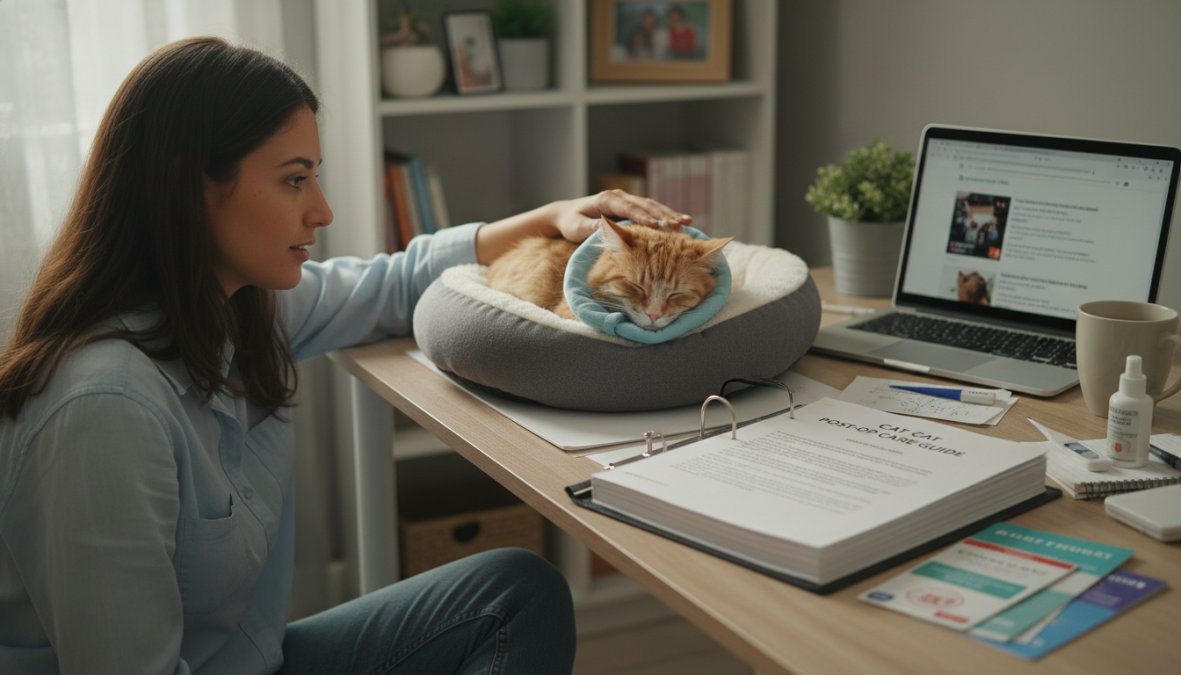
A tabby cat resting peacefully in a soft fleece pet bed on a hardwood floor at home, wearing a clear plastic recovery cone collar, with a person’s hand gently resting on the cat’s back in a warmly lit living room
The e-collar is non-negotiable during this period. Cats that lick or chew the incision site can cause serious wound complications, including infection and dehiscence (wound reopening). Most cats tolerate the collar within a few hours.
Key TakeawayThe single biggest factor in a smooth recovery is activity restriction during the first 72 hours. Owners who allow normal activity too soon are the primary driver of post-neuter complications.
Post-Neuter Care for Cats: Instructions, Warnings, and Tips
Post-neuter care for cats is largely about monitoring and restraint. The surgical site for a male cat neuter is small and heals quickly under normal circumstances. Your job is to keep the environment calm, the incision clean and undisturbed, and the cat comfortable.
Core post-operative instructions:
-
Administer any prescribed post-operative pain medication on schedule. Do not skip doses because your cat “seems fine.”
-
Check the incision site twice daily for the first week. Normal appearance: small, slightly pink, dry.
-
Keep the e-collar on at all times, including during sleep, until cleared by your veterinarian.
-
Restrict access to litter boxes with fine-grain clay litter for the first few days; shredded paper litter reduces contamination risk at the incision site.
-
Keep the recovering cat separated from other household pets until the incision has fully closed.
-
Do not bathe your cat or allow the incision to get wet for at least 10 days.
According to post-operative care guidance from the American Animal Hospital Association, consistent monitoring during the first week post-surgery is the most effective way to catch complications before they escalate.
Signs of Complications to Watch For
Most cat neuter procedures heal without incident. The complications that do occur are usually detectable early if you know what to look for.
Contact your veterinarian immediately if you observe any of the following:
-
Excessive swelling or bruising around the incision site beyond the first 24 hours
-
Discharge from the incision: any pus, blood, or fluid seeping from the wound
-
Persistent lethargy beyond 24-36 hours post-surgery
-
Loss of appetite lasting more than 24 hours after surgery day
-
Vomiting or diarrhea that continues past the first evening
-
Signs of pain including hunching, hiding, or vocalizing when touched near the abdomen
-
Redness or heat spreading outward from the incision (a sign of infection)
-
Open or gaping incision (dehiscence): if the wound appears to have reopened, this is an emergency
The thing nobody tells you about post-neuter care is that scrotal swelling is normal and expected in the first 24-48 hours, and many owners mistake it for a complication. The scrotum doesn’t disappear immediately after surgery; it gradually shrinks over several weeks. Mild swelling is not a reason to panic. Swelling that increases, reddens, or discharges is.
How to Find and Book a Trusted Neuter Clinic
The right clinic for your cat isn’t necessarily the cheapest or the closest. It’s the one that combines surgical competence, proper anesthesia monitoring, transparent pricing, and clear post-operative support.
Here’s what to evaluate when choosing a clinic:
-
Licensing: Confirm that the facility is staffed by licensed veterinarians, not just veterinary technicians operating independently.
-
Anesthesia protocols: Ask whether the clinic uses IV catheters, continuous monitoring equipment, and thermal support during surgery. These aren’t optional extras; they’re standard of care.
-
Vaccination requirements: A clinic that performs surgery without verifying vaccination status is cutting corners on patient safety.
-
Transparency on fees: Get a written estimate that itemizes what is and isn’t included before you commit to a booking deposit.
-
Post-operative support: Does the clinic provide a follow-up call? Is there a number to reach a veterinarian after hours if complications arise?
CorePet is a locally owned surgery center that focuses exclusively on spay, neuter, and dental procedures. The surgical team performs these operations daily, which means the experience level and procedural efficiency are meaningfully higher than a general practice that performs a neuter once a week. CorePet uses modern surgical techniques and equipment and is committed to individualized care at reasonable costs.
To book an appointment, visit the CorePet website and use the online scheduling tool. Check the pricing page for current fee structures before your appointment..
Choosing the right approach to your cat’s sterilization surgery shouldn’t feel like guesswork. CorePet focuses exclusively in spay, neuter, and dental procedures, which means every member of the surgical team is focused on exactly this type of care. With modern equipment, transparent pricing, and a commitment to individualized patient care, CorePet makes it straightforward to get your cat the procedure done safely and well. Book an appointment with CorePet and give your cat the standard of surgical care they deserve.
Frequently Asked Questions
What exactly happens during a cat neuter procedure?
During a cat neuter procedure, a licensed veterinarian administers anesthesia to ensure your cat is fully unconscious and pain-free. The surgeon then makes a small incision in the scrotum to remove both testicles, which are the primary reproductive organs producing testosterone. The incision is typically small enough to require no sutures or only dissolving ones. The entire surgical procedure usually takes under 30 minutes, and most cats are alert within a few hours of waking from anesthesia.
How long is the cat neuter recovery time?
Cat neuter recovery time is generally faster than for females. Most cats return to near-normal behavior within 24 to 48 hours. Full internal healing typically takes 7 to 10 days. During this period, restrict jumping, running, and rough play. Keep the incision site dry, and use an e-collar to prevent licking. Your veterinarian may prescribe post-operative pain medication for the first couple of days. By day 10, most cats are fully healed and cleared for normal activity.
Is the cat neuter procedure painful, and what are the anesthesia risks?
The cat neuter procedure itself is not painful because it is performed under general anesthesia. Post-operative discomfort is typically mild and managed with pain medication prescribed by your veterinarian. Anesthesia risks exist but are low in healthy cats. Risks can include adverse reactions or complications from underlying conditions. A pre-surgical health assessment helps minimize these risks. Choosing a clinic that uses modern equipment and experienced veterinary staff further improves anesthesia safety for your companion animal.
What should I do to prepare my cat for a neuter procedure?
To prepare your cat for a neuter procedure, withhold food for 8 to 12 hours before surgery — water restrictions vary by clinic, so confirm with your veterinarian. Ensure vaccinations such as DHPP, FVRCP, and rabies are current, as most clinics require proof before the surgical procedure. Arrange a quiet recovery space at home in advance. On surgery drop-off day, bring your cat in a secure carrier and arrive on time. Ask your clinic about any booking deposit requirements when scheduling your appointment.
How much does a cat neuter procedure cost, and are there low-cost options?
Cat neuter costs vary depending on location, clinic type, and whether additional services like microchip implantation or flea preventative are included. Low-cost clinics, mobile veterinary vans, and specialized surgery centers often offer more affordable rates than full-service practices. Some organizations offer financial assistance programs based on income or zip code eligibility. Checking a clinic's pricing page directly — like CorePet's — gives you a transparent breakdown of what the surgery fee covers so there are no surprises on the day.